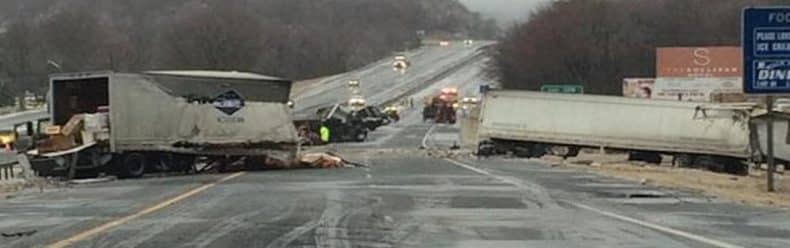

If someone else’s negligence or wrongful act took a family member’s life in Philadelphia, Pennsylvania law gives certain relatives the right to seek compensation. A wrongful death lawyer files the claim, protects the deadline, gathers the evidence and handles the court approval that Philadelphia requires before any money is distributed. At Pisanchyn Law Firm, we work on a contingency basis: you pay no fee unless we obtain a settlement or award.
You are grieving, and nobody should have to learn civil procedure while burying a loved one. This guide covers the essentials so you can make your first decisions with clear information.
TL;DR
- Only a spouse, children or parents hold the right to bring a wrongful death claim in Pennsylvania, and the proceeds follow intestacy rules.
- The general deadline is two years from the date of death, and medical cases have their own accrual rules.
- Damages can include funeral, medical and estate-administration costs, lost financial support, and lost services and companionship.
- Philadelphia requires court approval of the distribution through a motion assigned to an Orphans’ Court judge.
- Our firm handles these cases on contingency: no fee unless we win or settle.
Table of Contents
- What a wrongful death claim is in Pennsylvania
- Who can file in Philadelphia
- The deadline: act within two years
- What compensation can cover
- The court steps in Philadelphia
- Common causes we see
- How we help your family
- Talk to us before the deadline gets closer
- FAQ
- Sources
What a wrongful death claim is in Pennsylvania
Under 42 Pa.C.S. § 8301, an action can be brought for damages when a death is caused by another person’s wrongful act, neglect, unlawful violence or negligence. That covers many situations: a car or truck crash, a surgical error or missed diagnosis at a hospital, a dangerous product, a construction site collapse, or a criminal act.
The claim exists to compensate the survivors for what they lost. The Commonwealth Court has explained that wrongful death damages compensate survivors, not the decedent, and are aimed at their pecuniary losses, such as lost services and financial contributions.
Wrongful death and survival actions
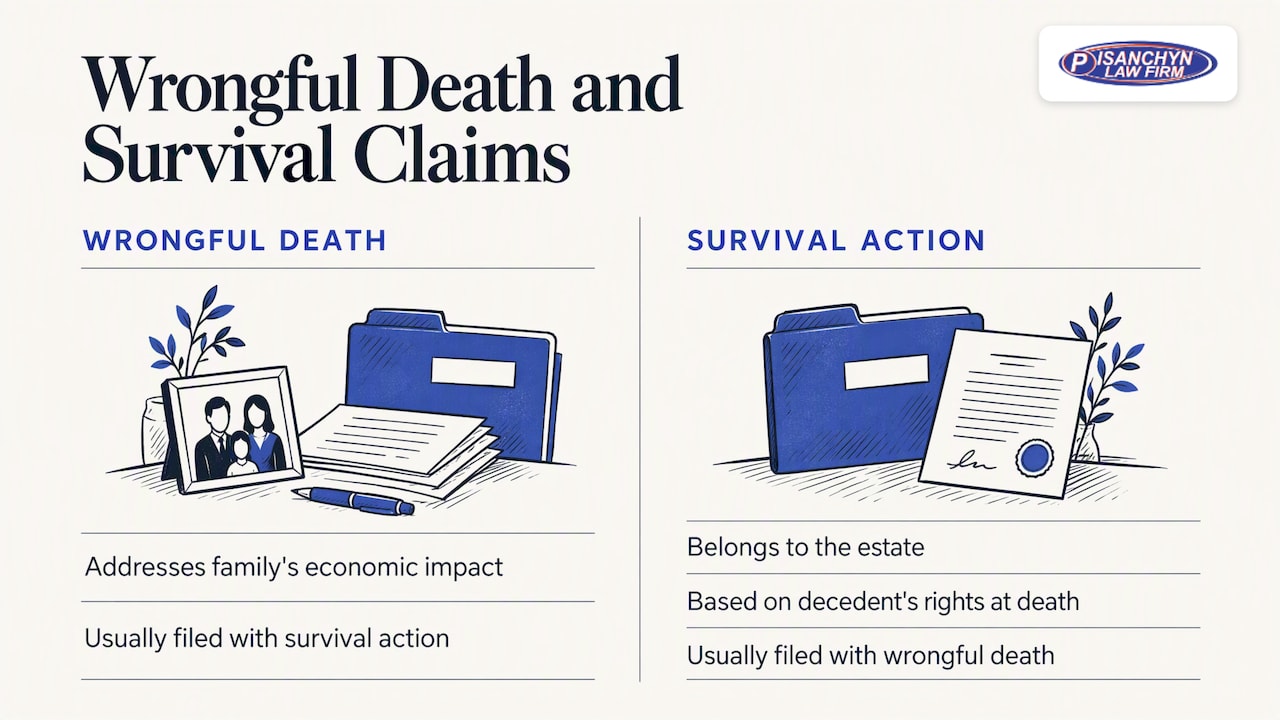
A second claim usually travels with the first. Section 8302 provides that causes of action survive the death of a plaintiff or defendant. A survival action belongs to the estate and rests on the rights the person had at the moment of death. The Pennsylvania Supreme Court has drawn that line: survival actions are based on the decedent’s rights, while wrongful death actions address the economic impact on surviving family. Because both come from the same incident, they are typically filed together. Our attorneys sort out which damages belong to which claim so nothing is left on the table.
Who can file in Philadelphia
The right to recover damages belongs to the decedent’s spouse, children or parents. A Philadelphia Court of Common Palais opinion confirms that beneficiaries are the spouse, children or parents, and proceeds are distributed under intestate succession whether or not there was a will. Siblings, grandparents and friends, however close, are not beneficiaries under this statute.
In practice, a personal representative of the estate usually brings the case on behalf of those beneficiaries. If family relationships are contested, for example a question about a child’s parentage, proof may be needed. Resources on DNA testing in probate disputes explain how biological claims get established when inheritance rights are questioned. We can tell you early whether your family faces that issue.
The deadline: act within two years
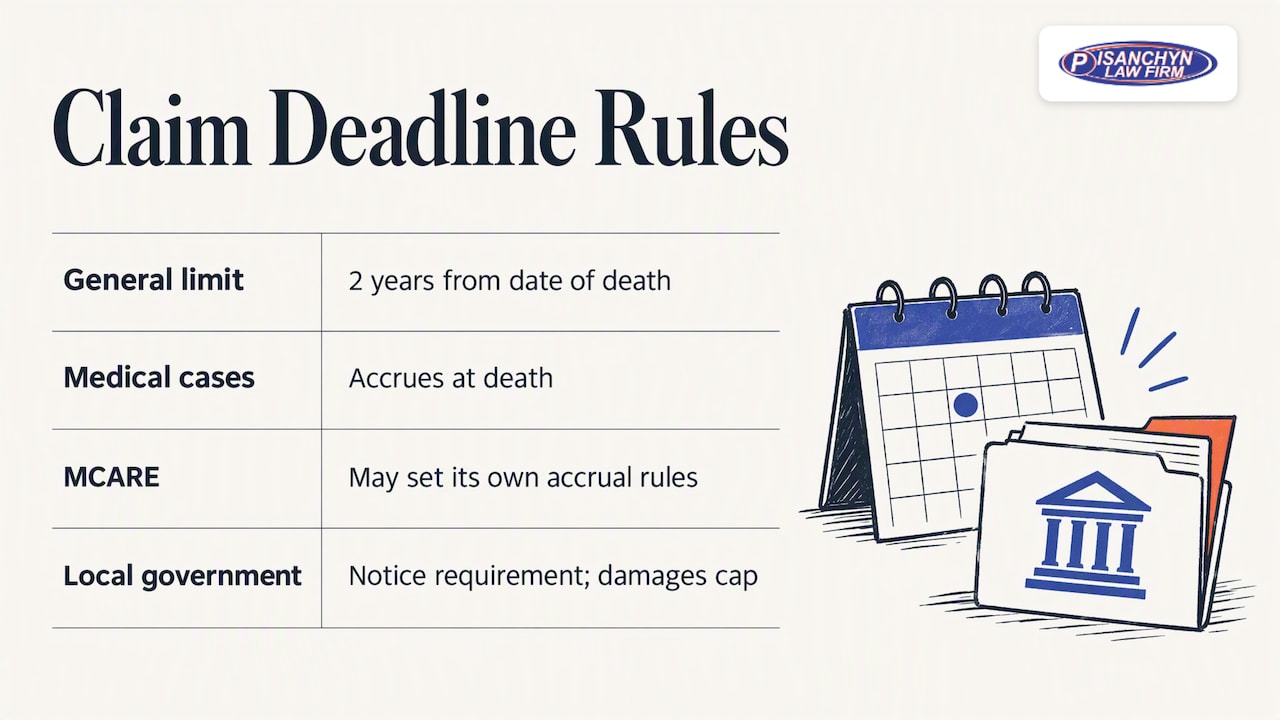
The general rule is a two-year statute of limitations, running from the date of death. For medical cases, the Pennsylvania Supreme Court has held that the two-year period for wrongful death and survival actions accrues at death, unless there was affirmative misrepresentation or fraudulent concealment of the cause of death. The same decision explains that specific statutes such as MCARE can set their own accrual rules in medical liability cases.
Exceptions are narrow, and a missed deadline usually ends the case. Do not wait for an investigation, a police report or an insurer’s offer to finish. Our overview of Pennsylvania personal injury deadlines, fault and your rights covers how time limits work across injury cases.
Claims against a city agency or other local government body follow additional rules, including a notice requirement and a damages cap. Speak to an attorney quickly if a municipal vehicle, road or property was involved. Our page on roadway defect accident cases explains one common situation.
What compensation can cover
The statute names specific categories. Section 8301© allows recovery of reasonable hospital, nursing, medical, funeral and estate-administration expenses caused by the injuries that led to the death. Beyond those, the Commonwealth Court described a claim as potentially seeking lost income and support, and the loss of society, companionship, services, contributions, tutelage and education.
In plain terms, your family may seek:
Financial losses
Funeral and burial costs, final medical bills, the income and benefits your loved one would have provided, and the value of work they did for the household, from childcare to home repairs.
Personal losses
The guidance, comfort and companionship a spouse, parent or child gave. These are harder to price, which is exactly why a well-prepared case matters. Insurers tend to undervalue them when no one pushes back.
Claims against government bodies
Where a local government party is responsible, 42 Pa.C.S. § 8553 limits damages to $500,000 in the aggregate for the same cause or occurrence. That cap does not apply to private defendants such as a trucking company or a hospital. We identify early who is actually responsible, because it shapes the entire strategy.
We do not promise any amount. Every case turns on its facts, the evidence and the defendants’ insurance.
The court steps in Philadelphia
A wrongful death case is not finished when an insurer agrees to pay. Philadelphia’s civil court materials describe that a motion package with a cover sheet, proposed order, memorandum of law and checklist is filed, and motions for approval and distribution are assigned to a judge of the Orphans’ Court Division. That protects the beneficiaries and ensures the split follows the law.
The typical path looks like this:
- Investigation. We secure the police or incident report, medical records, photographs, video and witness statements before they disappear.
- Appointing the personal representative. The estate needs someone with legal authority to act.
- Filing the claim. The wrongful death and survival actions are brought together, with expert witnesses retained where needed.
- Negotiation or trial. Most cases settle, but we prepare each one as though it is going before a jury.
- Court approval and distribution. The Orphans’ Court process closes the case and releases funds to the beneficiaries.
For a look at the broader process, read what happens when you file an injury claim in Pennsylvania.
Common causes we see
Negligence-based deaths include car accidents and medical malpractice, and a death caused by an intentional act, including a crime, can also support a claim, as Nolo’s Pennsylvania overview notes. Within our practice areas, that includes:
- Crashes involving distracted drivers or DUI drivers
- Truck and commercial vehicle collisions
- Medical misdiagnosis, surgical error and hospital negligence
- Defective medical devices and other dangerous products
- Construction and workplace accidents
- Premises hazards, which our guide to Pennsylvania slip and fall liability explains
Some families face a death where the cause is contested. Our page on suicide and wrongful death claims addresses those circumstances with care.
How we help your family
We fight for families who have lost someone to another party’s carelessness. Our firm describes its approach as direct attorney access, thorough case preparation built around your family’s situation, aggressive advocacy, and availability when you need us. We bring in expert witnesses where a case requires them, and we take on the insurers so you can focus on your family.
Wrongful death cases are handled on contingency. You owe no fee until we secure a settlement or award. Our firm reports over $100 million recovered for clients across Pennsylvania in more than 20 years of practice.
Learn more on our Pennsylvania wrongful death lawyers page, or see the full list of our practice areas.
Talk to us before the deadline gets closer
If you lost a spouse, parent or child because of someone else’s actions, we will review what happened, explain your options and tell you honestly what the next step should be. There is no cost to start the conversation, and no fee unless we recover for your family.

Contact Pisanchyn Law Firm to schedule a free case review.
FAQ
How long do I have to file a wrongful death claim in Philadelphia?
The general deadline is two years from the date of death. In medical liability cases the period also accrues at death, unless the cause of death was fraudulently concealed. Because exceptions are narrow, contact a lawyer as soon as you can.
Can a sibling or a fiancé file a wrongful death claim?
Not as a beneficiary. The statute limits the right to recover to a spouse, children or parents. A sibling or partner may still have a role if they are the estate’s personal representative, so ask an attorney about your specific situation.
Does the money go through the estate and will?
Wrongful death proceeds are distributed under intestacy laws whether or not the decedent had a will, and they are not subject to the decedent’s creditors. In Philadelphia, distribution requires approval from an Orphans’ Court judge.
What does a wrongful death lawyer cost?
At Pisanchyn Law Firm, we work on contingency. You pay no fee unless we obtain a settlement or award. We explain the fee agreement in writing before you sign anything.
Sources
- 42 Pa.C.S. § 8301, Death action
- 42 Pa.C.S. Chapter 83
- 42 Pa.C.S. § 8553, Damages
- Pennsylvania Supreme Court, Extendicare appeal
- Commonwealth Court opinion, September 27, 2017
- Philadelphia Court of Common Pleas, Orphans’ Court opinion
- Pennsylvania Supreme Court, Quinlan decision
- Philadelphia Office of Civil Administration guide
- Nolo, Pennsylvania Wrongful Death Law
- DNA testing in probate and inheritance disputes
Recommended
- Pennsylvania Wrongful Death Lawyers
- Harrisburg Wrongful Death Lawyers
- Scranton Wrongful Death Lawyers
- Suicide and Wrongful Death Claims