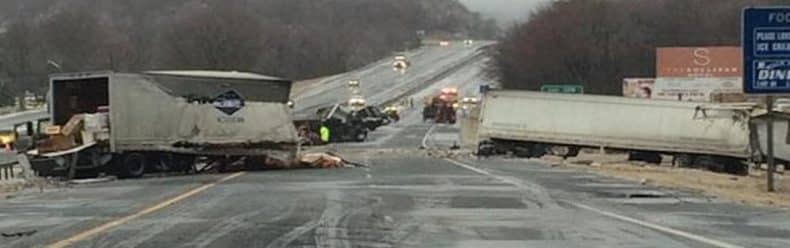

An 18-wheeler accident lawyer investigates the crash, identifies every party that may be responsible, preserves the evidence the trucking company controls, and fights the insurers for the full value of your claim. If you or someone you love was hurt or killed in a crash with a tractor-trailer in Pennsylvania, the first days matter most, because key records are kept for a limited time. Here is what these cases involve and what to do now.
TL;DR
- Trucking cases often involve more than the driver: the motor carrier and other companies may share responsibility.
- Federal rules require carriers to keep drivers’ duty logs for only six months, so evidence can be lost quickly.
- In Pennsylvania, survival claims and wrongful death claims run on different clocks, so do not wait to speak with a lawyer.
- Our firm handles truck accident cases on a contingency basis: you pay no fee until a settlement is achieved.
- Get medical care first, then call an attorney before you talk to the trucking company’s insurer.
Table of Contents
- What an 18-wheeler accident lawyer actually does
- What to do after a crash with an 18-wheeler
- Why the first weeks decide so much
- Who can be held responsible
- Compensation after a truck crash
- How to choose an 18-wheeler accident lawyer
- Talk to Pisanchyn Law Firm
- FAQ
- Sources
What an 18-wheeler accident lawyer actually does
A crash with a fully loaded tractor-trailer is not a larger version of a fender bender. The injuries are often catastrophic: spinal cord damage, traumatic brain injury, amputations, and death. The defendants are often a company with an insurer and a legal team already moving before you leave the hospital.
Your lawyer’s job is to level that field. That means gathering evidence, working with expert witnesses, documenting your medical needs and lost income, negotiating with insurers, and filing suit and trying the case when a fair settlement is not offered. At Pisanchyn Law Firm, our truck accident practice is built around direct attorney access, thorough case preparation, and aggressive advocacy. Each case gets a strategy built around the client, not a template.
You may need a lawyer if you have serious injuries, if a family member died, if the trucking company or its insurer is disputing fault, or if you are being pressed for a recorded statement. If you are weighing whether it is worth it, our guide on hiring an attorney after a crash in Pennsylvania walks through the reasoning.
What to do after a crash with an 18-wheeler
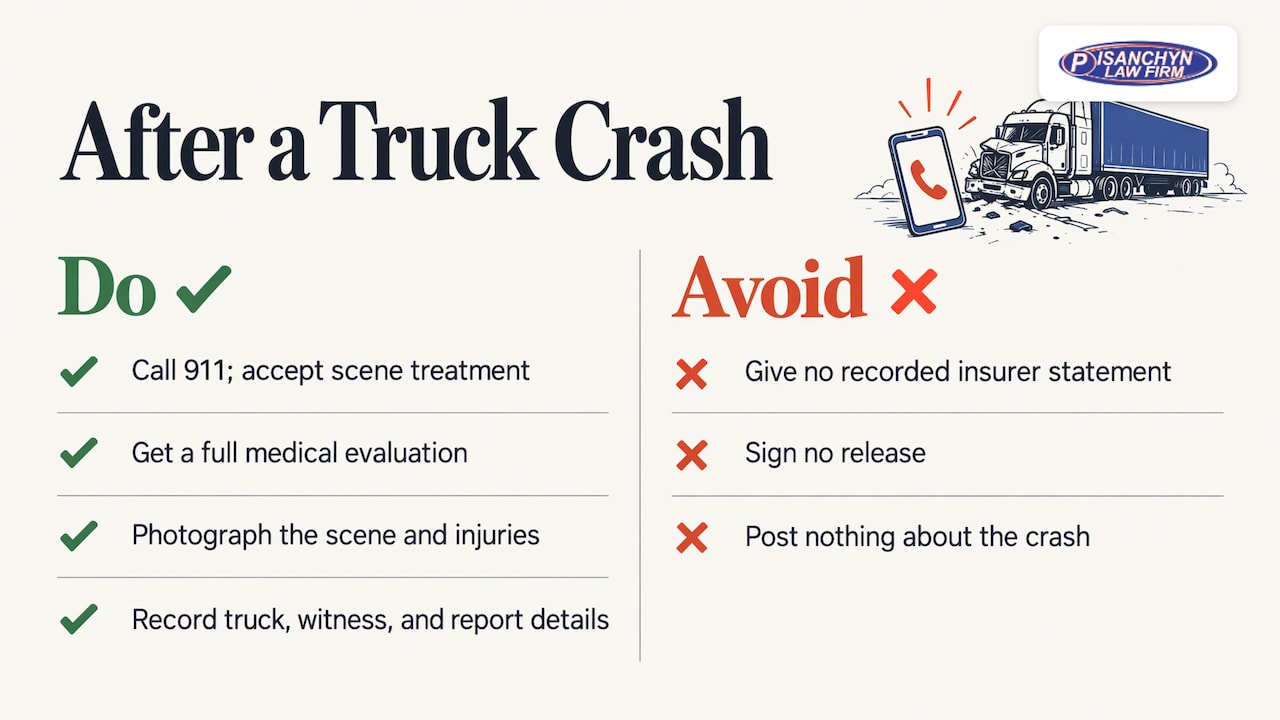
Your health comes first. Call 911, accept treatment at the scene, and get a full medical evaluation even if you feel “fine.” Adrenaline hides injuries, and gaps in treatment give insurers an argument later.
If you are able, take these steps while still at the scene or soon after:
Photograph the vehicles, the road, skid marks, damage, and your injuries. Note the truck’s company name, the USDOT number on the cab door, the license plate, and the driver’s name. Get names and phone numbers of witnesses. Ask the responding officer for the report number.
Then stop. Do not give a recorded statement to the trucking company’s insurer, do not sign a release, and do not post about the crash online. Call a lawyer who can send a preservation demand to the carrier right away.
Why the first weeks decide so much
The most important truck evidence is not in your hands. It sits with the carrier, and some of it is discarded on a schedule.
Federal rules require a motor carrier to keep a driver’s records of duty status and supporting documents for six months, along with a backup copy of electronic logging device data. The regulation itself, 49 C.F.R. §395.8, sets the same minimum of six months from receipt. FMCSA also notes that original ELD records stay retained after edits, but access is limited to that six-month period.
Six months can pass quickly while you are in surgery and rehab. A letter demanding that the carrier preserve logs, dashcam footage, maintenance files, and driver records is one of the first things we send. Other evidence worth securing includes:
The truck’s event data recorder, which can show speed and braking. Dispatch records and delivery schedules that show pressure on the driver. Inspection and repair history for brakes, tires, and trailer. Cargo loading records. Drug and alcohol testing records. The driver’s qualification file.
That last item matters because carriers have a duty to check their drivers. Federal regulations require a carrier to obtain and review each employed driver’s motor-vehicle record at least every 12 months and keep the review in the qualification file. A missing or ignored review can say a lot about how a company operates.
Who can be held responsible
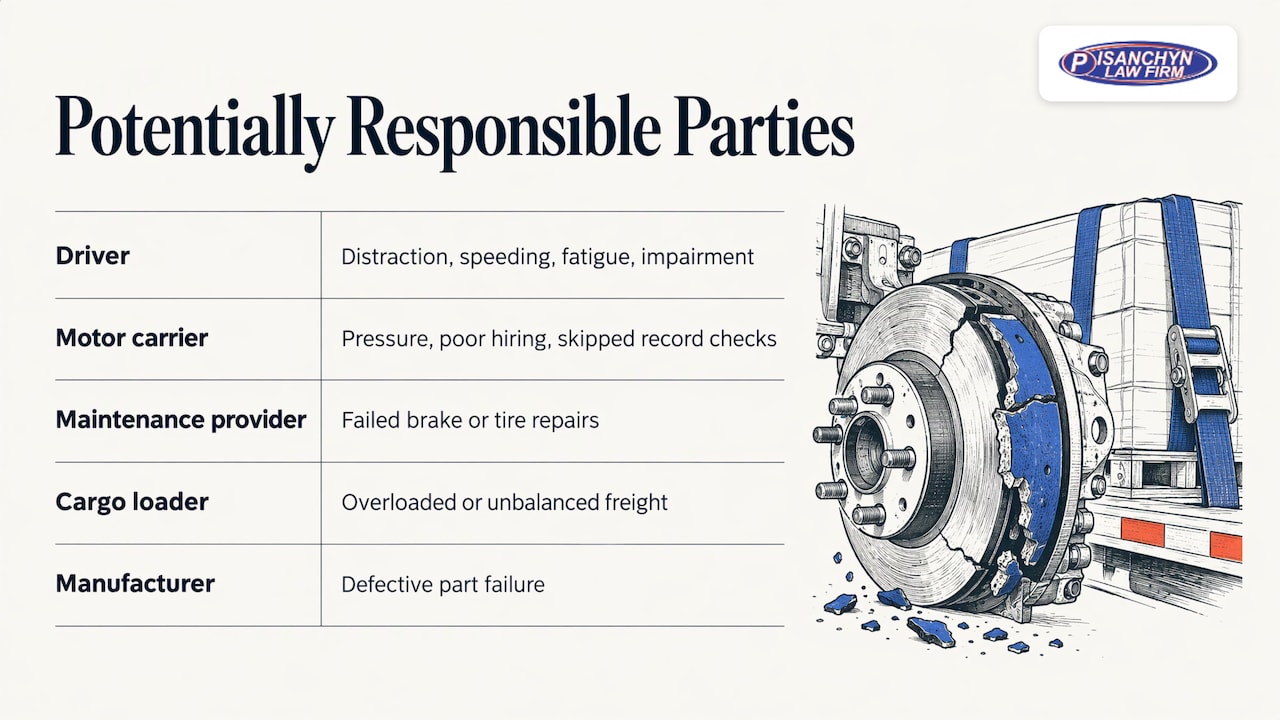
Many people assume the driver is the only target. Often he or she is not. Depending on the facts, responsibility may reach:
The driver, for distracted driving, speeding, fatigue, or impairment. The motor carrier, for pressuring drivers, poor hiring and supervision, or skipping required record checks. A maintenance provider that failed to fix brakes or tires. A cargo loader whose overloaded or unbalanced freight contributed to a rollover or jackknife. A manufacturer, if a defective part failed.
Proving this means rebuilding what happened and why. Our page on truck accident liability explains how these theories fit together. Because of our network of expert witnesses, we can bring in accident reconstruction and other specialists where the case calls for it.
Fault also affects your recovery. Insurers look for any way to assign blame to the injured person, so what you say and do after the crash matters. A lawyer can respond to those arguments with evidence.
Compensation after a truck crash
A truck accident claim generally seeks to cover losses that flow from the crash. These commonly include current and future medical care, lost wages and reduced earning capacity, pain and suffering, and, in the most serious cases, long-term care needs. Our overview of trucking accident injury compensation breaks down each category.
No lawyer can promise a particular result, and we do not. What we do promise is careful preparation, so that the value of your claim is documented and defended rather than left on the table. Our firm has settled over $100 million for clients across Pennsylvania, but every case turns on its own facts.
If a loved one died in a trucking crash
Pennsylvania law treats two types of claims separately. A wrongful death action exists for the benefit of the deceased’s spouse, children, or parents, and a survival action belongs to the estate. According to a Pennsylvania Superior Court opinion, the limitations period for a survival action runs from the date of the tort, while the wrongful death action’s runs from the date of death.
That difference is one reason families should not wait. Read more on who can file a wrongful death claim in Pennsylvania, or speak with our Pennsylvania wrongful death lawyers. We also serve families through our Pittsburgh, Harrisburg, and Scranton offices’ communities.
If you were driving the truck
If you were injured while working as a driver, workers’ compensation may apply, and a third party may also be responsible. Our article on a workers’ comp lawyer for truck drivers injured on the job explains how those claims work.
How to choose an 18-wheeler accident lawyer
Look for a firm that handles trucking cases in Pennsylvania courts, not one that treats them as an add-on. Ask who will actually answer your calls and whether you can reach your attorney directly. Ask how the firm prepares a case, what experts it works with, and whether it is willing to go to trial. Confirm the fee arrangement in writing.
If you are near a major city, local knowledge helps. We have written guides for Philadelphia trucking accident cases and for Pittsburgh truck accident victims.
Talk to Pisanchyn Law Firm
Pisanchyn Law Firm has represented injured Pennsylvanians for over 20 years. Our truck accident and commercial vehicle accident attorneys investigate quickly, work with expert witnesses, and stay available to clients throughout recovery. You pay no fee unless we obtain a settlement for you. See our full list of practice areas or contact us through our main site to discuss what happened.
The sooner you call, the sooner we can lock down the evidence the carrier controls.
FAQ
How much does an 18-wheeler accident lawyer cost?
At our firm, you pay no fee until a settlement is achieved. The fee comes from the settlement or award, so you do not pay out of pocket to get started. Ask any lawyer to explain the arrangement in writing before you sign.
How soon should I call a lawyer after a truck crash?
As soon as you are medically stable. Carriers must keep driver duty records for only six months under federal rules, and an early preservation letter helps protect that evidence. Early contact also keeps you from making statements to insurers that hurt your claim.
Can I sue the trucking company and not just the driver?
Often yes. Carriers have duties to review driver records and maintain their vehicles, and a failure there can create responsibility of its own. Your lawyer examines the carrier’s files to see where it fell short.
What if a family member died in the crash?
Pennsylvania separates wrongful death claims, brought for the benefit of the spouse, children, or parents, from survival claims brought for the estate. Their time limits are measured from different dates, so speak with an attorney promptly to protect both.
Sources
- FMCSA: How long must a motor carrier retain ELD records
- FMCSA: Editing and Annotations
- 49 CFR § 395.8, Driver’s record of duty status
- 49 CFR § 391.25, Annual inquiry and review of driving record
- Pennsylvania Superior Court opinion on survival and wrongful death actions
Recommended
- Summer Tractor Trailer Accidents in Pennsylvania
- Philadelphia Trucking Accident Lawyer: What to Do and How to Choose
- Truck Accident Liability
- Commercial Vehicle Accident Attorneys