

You may have a dental malpractice claim if a dentist, orthodontist or other dental professional gave you care below the accepted standard and you were harmed as a result. A dental malpractice attorney builds that case. The attorney gathers your records, lines up dental experts, deals with the insurer and takes the claim to court if it will not settle fairly. Dental negligence is a form of medical malpractice, and the same rules about proof, experts and deadlines apply.
TL;DR
- Dental malpractice means substandard care that causes you real harm, not just a result you dislike.
- A claim generally needs four things: a dentist-patient relationship, a breach of the standard of care, causation and measurable damages.
- Expert testimony from a qualified dental professional is almost always required.
- Filing deadlines are strict and differ by state, so speak with an attorney early.
- Our firm works on a no-fee-unless-we-win basis, so you pay nothing up front.
Table of Contents
- What counts as dental malpractice
- Common dental errors that lead to claims
- What to do after a suspected dental mistake
- Why you almost always need an expert
- Deadlines: why timing matters
- How a dental malpractice case moves forward
- What compensation may cover
- How we can help
- FAQ
- Sources
What counts as dental malpractice
Bad outcomes happen in dentistry. Malpractice is something narrower. Nolo explains that it occurs when a dental professional provides sub-standard care and the patient suffers injury or other harm as a result.
The standard of care is the yardstick. Justia describes it as what another dentist with similar experience and qualifications would do in the same or a similar situation. The American Bar Association ties it to accepted standards of practice and says you must show the deviation was a proximate cause of your injury.
In plain terms, a claim is built on four elements, as Justia lists them:
- A dentist-patient relationship existed.
- The dentist breached the duty owed to you.
- The breach directly caused your injury.
- You suffered measurable harm or damages.
If one link is missing, the claim is weak. That is why a careful review of your records comes before anything else.
Common dental errors that lead to claims
The types of mistakes that can support a claim are broader than most patients expect. Nolo lists improper tooth extraction, failure to diagnose conditions such as TMJ dysfunction or oral cancer, failure to treat complications like infection, failure to supervise staff, improper anesthesia, failure to refer to a specialist and lack of informed consent.
FindLaw adds examples such as a root canal that causes lingual nerve damage, a wrongful extraction, an implant placed over the wrong tooth and a hygienist using unsanitary tools that causes infection.
Several of these overlap with areas we already handle for patients. If sedation or general anesthesia went wrong, see our page on anesthesia malpractice. If a dentist missed an infection or a tumor, our misdiagnosis attorneys can explain how delayed diagnosis claims work. If a dental implant or other device failed, read about medical device malfunction claims. For a wider view, our guide to common types of medical malpractice shows where dental negligence fits.
What to do after a suspected dental mistake
What you do in the first days matters for both your health and your case.
- Get corrective care first. Your health comes before the claim. FindLaw advises a second opinion, which also helps show whether the first dentist was negligent. Pain, swelling, fever or numbness that does not fade needs prompt attention from another dentist or a physician.
- Keep everything. Save X-rays, treatment notes, bills, prescriptions, consent forms, photos of your injury and any texts or emails with the office.
- Write down what happened. Note dates, symptoms, what you were told and how the injury affects eating, work and sleep.
- Request your full records in writing. Do it before you confront the practice.
- Be careful with the dentist’s insurer. Do not sign releases or accept a quick payment before you know the full extent of your harm.
If a cracked or damaged tooth is part of your situation, this overview of cracked tooth treatment steps explains what a first consultation typically involves.
Why you almost always need an expert
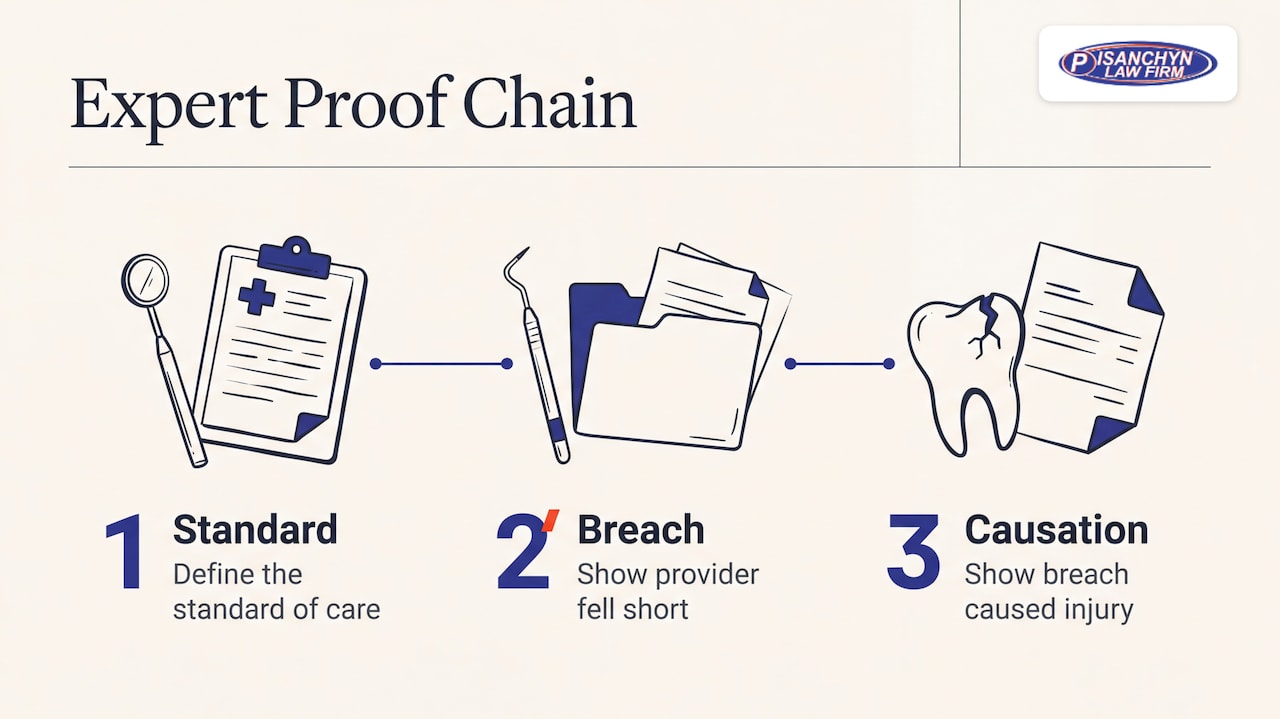
Dentistry is technical, and a jury cannot judge a root canal by instinct. The California Courts self-help guide says that when you sue over care you received, you almost always need an expert witness to show what the standard of care was, that the provider did not meet it and that this caused your injury.
Qualification rules are exacting and local. In a Michigan case, Gaskin v. Rider, a court dismissed a malpractice case because the expert behind the affidavit of merit did not meet the statutory requirements. A claim can fail on paperwork even when the care was poor. An attorney who knows the expert requirements where you live protects you from that.
Experts are also costly. The same California guide notes that expert witnesses are usually very expensive in this kind of case, and that those fees are recovered only in limited circumstances. Ask any attorney how case costs are handled and who fronts them. Our firm’s approach is built on a no-fee-unless-we-win structure, and we work with a network of expert witnesses to prepare each case.
Deadlines: why timing matters
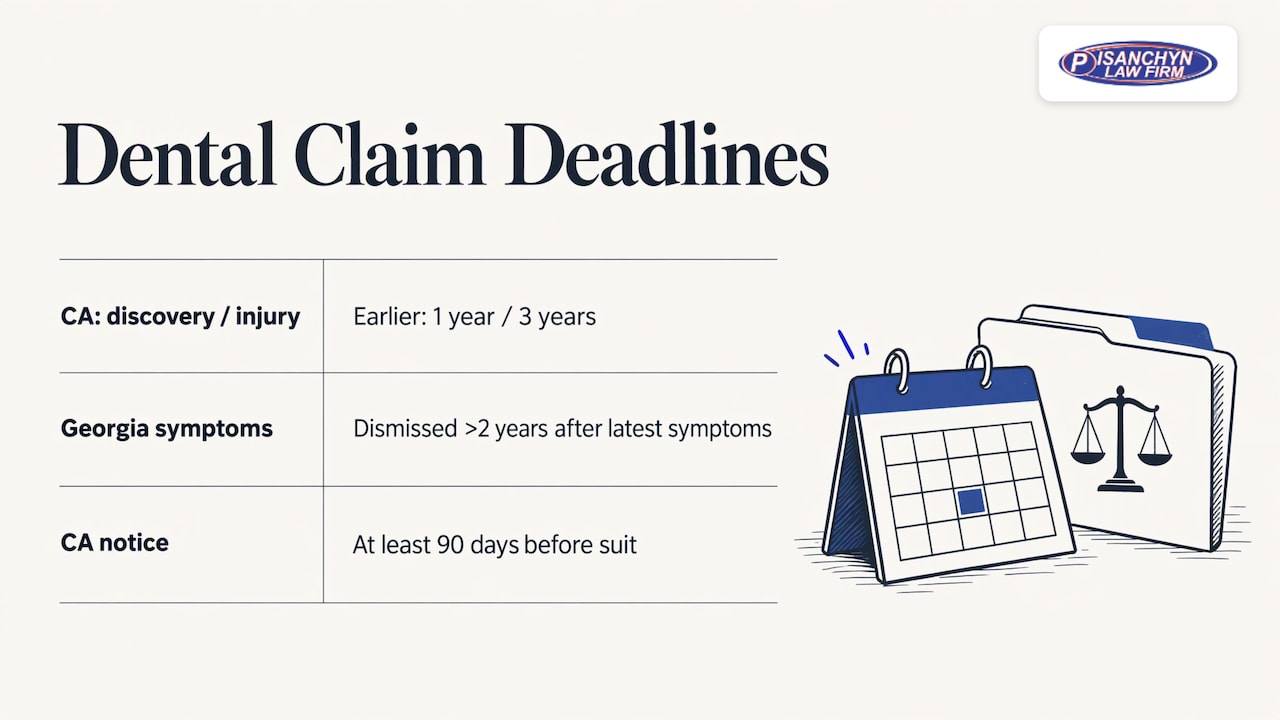
Every state sets a statute of limitations for malpractice, and missing it can end your claim no matter how strong the facts. The rules differ widely. In California, you must sue by the earlier of one year after you discovered or should have discovered the injury, or three years from the date of injury, with some exceptions. A Georgia appeals court in Brown v. Coast Dental of Georgia upheld dismissal of a complaint filed more than two years after the latest undisputed symptoms.
Some states also require advance written notice. California, for example, requires notice to the provider at least 90 days before you sue. Do not try to work out your own deadline from a general website. If you were treated in Pennsylvania, speak to an attorney as soon as you suspect a problem, because every week of delay can shrink your options.
How a dental malpractice case moves forward
Justia describes the general path: meeting the filing deadline, obtaining an expert opinion (often an affidavit of merit), filing the complaint, discovery, and then settlement or trial. In practice that means:
- Case review. We look at your records and the timeline of treatment and harm.
- Expert opinion. A qualified dental professional evaluates whether the care fell below the standard and whether it caused your injury.
- Filing and discovery. Both sides exchange records and take testimony.
- Negotiation or trial. Many cases settle. Those that do not are prepared for a courtroom.
Timelines vary with the injury, the number of experts and how hard the insurer fights, so no honest attorney can promise a date.
What compensation may cover
Justia says successful dental malpractice claims typically involve economic damages, such as the cost of corrective procedures and other medical care, lost wages and lost future earning capacity. They also involve non-economic damages, such as pain and suffering, emotional distress, mental anguish and loss of enjoyment of life. Punitive damages are possible only in rare, egregious or reckless cases.
What your case is worth depends on the severity and permanence of the injury, the cost of repairing it, how it affects your work and daily life, and the strength of the expert evidence. Keep your repair estimates and bills. They are the backbone of the damages claim.
How we can help
We represent injured patients across Pennsylvania in medical malpractice matters, including surgical error, hospital negligence and misdiagnosis. We prepare each case thoroughly, with client-specific strategy, direct attorney access and aggressive advocacy. We take cases with no fee unless we win a settlement or award.

If a dental procedure left you with nerve damage, infection, a missed diagnosis or lasting pain, tell us what happened. Reach us through our Pennsylvania injury practice, and we will explain your options and the deadlines that may apply to you.
FAQ
Is a bad dental result the same as malpractice?
No. Malpractice requires care below the accepted standard and harm caused by that failure. A complication that can happen even when the dentist does everything right is not necessarily negligence. An expert review of your records is how that line gets drawn.
Do I need an expert to bring a dental malpractice claim?
Almost always. Courts expect a qualified expert to explain the standard of care, how it was breached and how that caused your injury. Local rules decide who qualifies, so your attorney must follow them closely.
How long do I have to file?
It depends on your state, and some states count from the date you discovered the injury. Deadlines can be as short as one or two years. Speak with an attorney right away so your claim is not lost to timing.
What can I recover in a dental malpractice case?
Compensation can include corrective treatment costs, other medical expenses, lost wages, lost earning capacity, pain and suffering and emotional distress. Punitive damages are rare. The value turns on your injury and the evidence.
What does it cost to hire us?
We work on a contingency basis. You owe no attorney fee unless we obtain a settlement or award for you.
Sources
- Can I File a Lawsuit for Dental Malpractice? (Nolo)
- You Don’t Have To Gnash Your Teeth Over A Dental Malpractice Claim (American Bar Association)
- Can I Sue My Dentist? (FindLaw)
- Dental Malpractice Law (Justia)
- Suing a healthcare provider (California Courts Self-Help)
- Gaskin v. Rider DMD (Justia)
- Brown v. Coast Dental of Georgia, PC (Justia)
Recommended
- Common Types of Medical Malpractice
- Medical Misdiagnosis Attorneys
- Medical Device Malfunction Attorneys
- Hospital Negligence Attorneys