A boating accident lawyer investigates the crash, identifies every party who may be responsible, deals with the insurance companies and fights for compensation for your medical bills, lost income, pain and, in the worst cases, the loss of a family member. If you were hurt on a Pennsylvania lake, river or reservoir, the steps you take in the first days, including reporting the accident and preserving evidence, can shape the whole claim. This guide explains those steps, how fault works here, what compensation may be available and how we can help.
TL;DR
- Report serious boating accidents quickly. Federal rules set a 48-hour deadline when someone dies, needs treatment beyond first aid or disappears.
- Pennsylvania uses comparative negligence, so you can still recover if your share of fault is not greater than the other party’s, though your damages are reduced by your percentage.
- More than one party can be responsible: an operator, a boat owner, a rental company, a manufacturer or a marina.
- Boat insurance often carries only modest medical-payments coverage, so serious injuries usually require a claim against a liable party.
- We handle injury claims on a contingency basis. You pay no fee unless we win or settle your case.
Table of Contents
- What a boating accident lawyer does after a crash
- Report the accident first: what the rules require
- What to do in the hours and days after a boating accident
- Who can be held liable for a boating accident
- How fault works in Pennsylvania
- Which laws apply: state law or maritime law
- What compensation may be available
- Boating injuries we see
- Swimming pool injuries and drowning claims
- How we charge: no fee unless we win
- Our perspective: why the first week matters most
- Talk to a Pennsylvania injury attorney
- FAQ
- Sources
What a boating accident lawyer does after a crash
Most people hurt on the water have never dealt with a marine claim. The insurance adjuster calls within days, often before you have finished treatment, and asks for a recorded statement. That is where a claim can lose real value.
A lawyer takes that burden off you. In a boating case, that work usually includes:
Investigating the scene and the vessel. Boats do not have black boxes the way trucks do, and evidence disappears fast. Wreckage gets repaired, witnesses scatter and weather erases conditions. We move quickly to secure photographs, the vessel itself, maintenance records, rental agreements and witness names.
Working with official reports. Law enforcement and state officials document many accidents. We obtain those reports and check them against the physical evidence and your account, because a first report is not always right about who was at fault.
Bringing in experts. Serious cases often turn on technical questions: was the engine defective, was the boat overloaded, was the operator impaired, was a navigation light out. Our firm works with a network of expert witnesses for exactly these questions.
Handling the insurers. We deal with the insurance companies so you do not have to give statements that are later used against you. We then negotiate, and if the offer does not reflect what you have lost, we are prepared to file suit and take the case to a jury.
Report the accident first: what the rules require
Reporting is not optional when an accident is serious, and the report also creates a record that supports your claim.
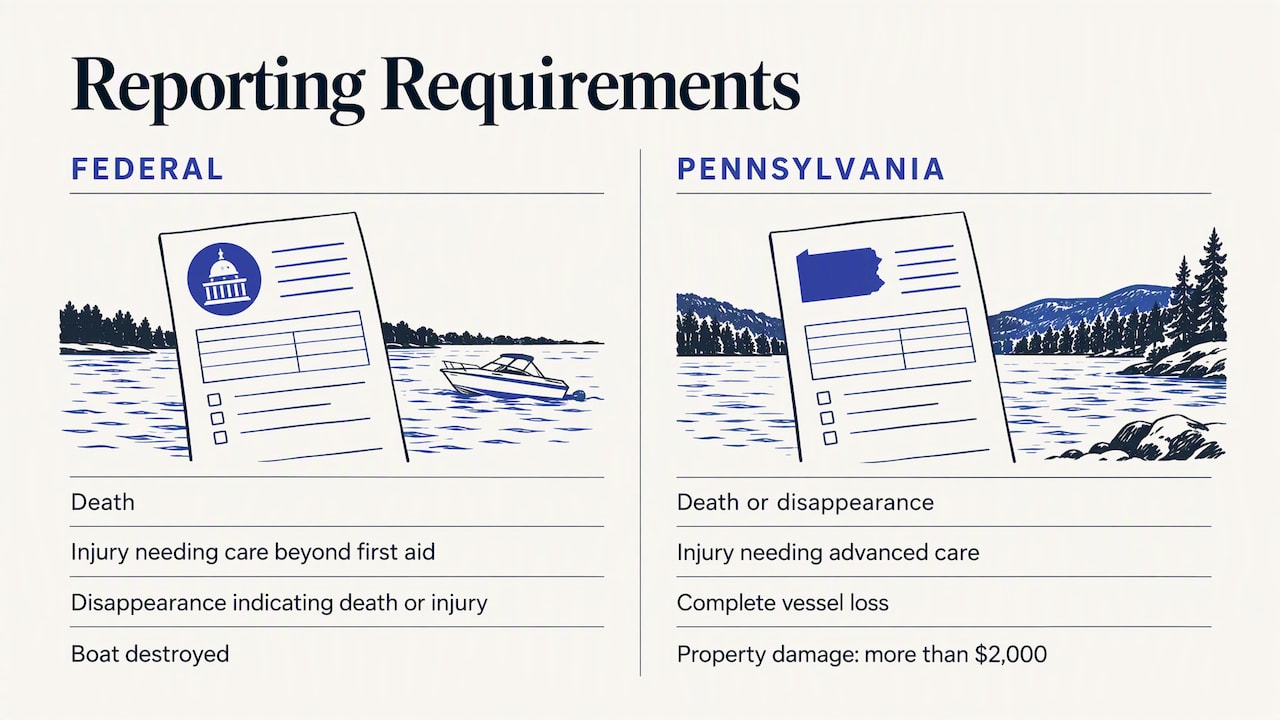
According to the U.S. Coast Guard’s boating accident reporting rules, federal law requires a report if a person dies, is injured and needs treatment beyond first aid, disappears under circumstances that indicate death or injury, the boat is destroyed, or property damage reaches $2,000. Some states and territories set a lower damage threshold. The same page explains that the report is due within 48 hours when a person dies within 24 hours, needs medical treatment beyond first aid or disappears. Otherwise it is due within 10 days of the accident or the death.
Pennsylvania adds its own rule. The Pennsylvania Fish and Boat Commission states that a written report to the Commission is required when someone dies or disappears, an injury requires advanced medical treatment beyond first aid, property damage totals more than $2,000, or the vessel is a complete loss.
The operator usually files the report, and that may be the person who caused the crash. If you are an injured passenger, do not assume the report describes the accident accurately. Ask for a copy, and tell your attorney if anything in it looks wrong.
What to do in the hours and days after a boating accident
Your health comes first, and the evidence comes second. Here is the order that protects both.
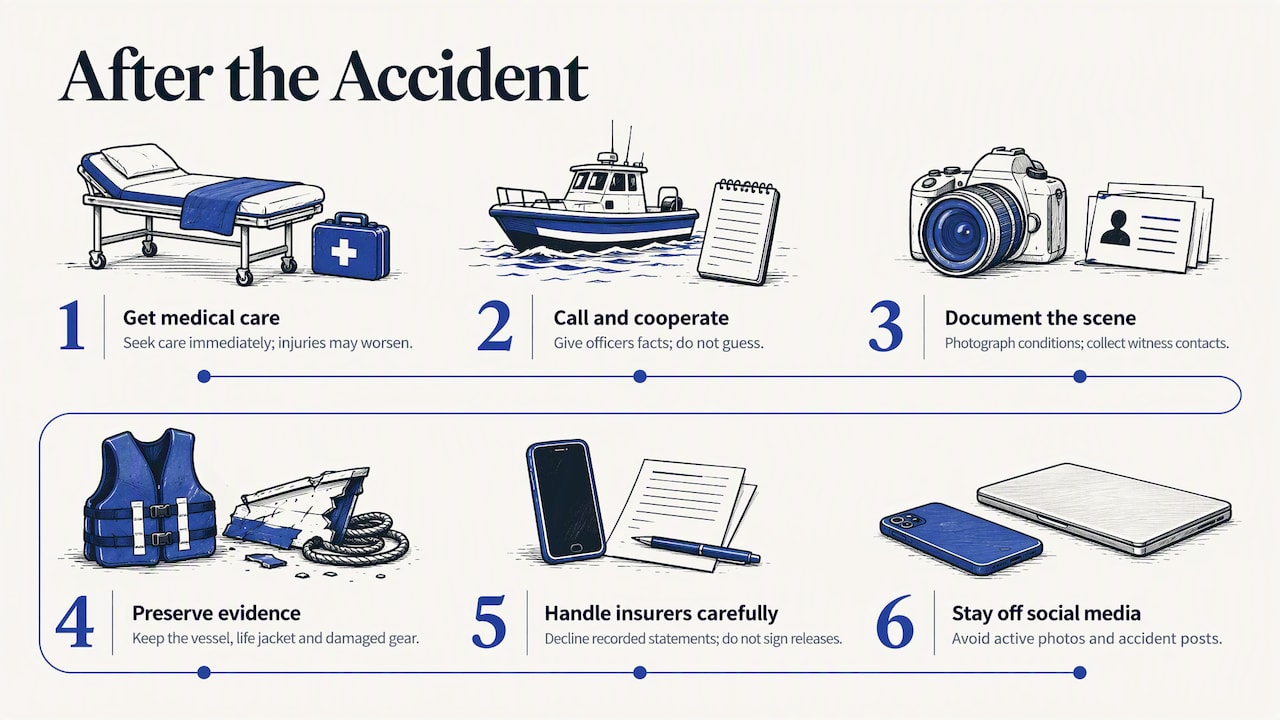
Get medical care immediately. Drowning injuries, head injuries, spinal injuries and hypothermia can be worse than they feel at the scene. A prompt medical record also links your injuries to the accident, which insurers look for.
Call for help and cooperate with officers. Give a factual statement to the responding officers. Do not guess about speed, distance or who was at fault.
Document everything you can. Photograph the boats, the damage, your injuries, the weather, the water conditions and the location. Collect names and phone numbers from everyone aboard and from anyone who saw it. Write down what you remember while it is fresh.
Keep the physical evidence. Do not repair or sell the vessel, and keep your life jacket, clothing and any damaged gear.
Be careful with insurers. Give your name and the basic facts if asked, but decline a recorded statement and do not sign a release until you have spoken with an attorney. Early offers are usually made before anyone knows the full cost of your injuries.
Stay off social media. Photos of you active, or a casual post about the accident, will be read by the other side.
Who can be held liable for a boating accident
People assume the other boat’s driver is the only target. In practice, several parties may share responsibility.
The boat operator. Speeding, inattention, operating under the influence, ignoring right-of-way rules and failing to keep a lookout are common causes of crashes.
The boat owner. An owner who lends a boat to an inexperienced or intoxicated person, or who fails to maintain it, may be responsible.
A rental or charter company. Companies that rent boats, pontoons or personal watercraft must provide equipment that is safe, working and properly equipped, and in many cases must make sure renters can operate it.
A manufacturer or repairer. If a steering failure, fuel leak, faulty throttle, defective life jacket or other equipment problem contributed, a product claim may be possible. Our dangerous product practice handles injuries caused by defective equipment.
A marina, dock or property owner. Unsafe docks, missing railings, poor lighting and neglected ramps can all cause injuries, and these are treated much like other premises cases.
An employer. If you were hurt while working on a vessel or around the water, the rules can be very different, and other compensation systems may apply. Sorting out which one governs your case is one of the first things an attorney does.
The National Transportation Safety Board investigates selected marine accidents, and its reports can summarize factual information and include safety recommendations. Not every crash receives that attention, and the agency’s work on a serious accident can take a long time, often 12 to 24 months. You should not wait for it. Your own investigation has to start now.
How fault works in Pennsylvania
One of the most important questions in any injury case is whether you share blame. Pennsylvania follows a comparative negligence rule, set out in 42 Pa.C.S. § 7102. Under it, you are not barred from recovery as long as your negligence is not greater than the negligence of the party you are blaming. Your damages are then reduced in proportion to your share of fault.
Here is a simple example, not a prediction. If a jury found your damages were $200,000 and decided you were 20 percent at fault, you would recover $160,000. If the jury found you more at fault than the defendant, you would recover nothing.
That is why insurers work so hard to push blame onto the injured person. They will say you were not wearing a life jacket, you were standing while the boat was moving, or you knew the driver had been drinking. Each of those arguments can be answered, but only with evidence gathered early.
Which laws apply: state law or maritime law
Boating cases sit at the border of state and federal law. A crash on a lake entirely inside Pennsylvania is usually handled under state negligence law, but the location, the type of vessel and the nature of the activity can bring federal maritime law into play. That matters because the two systems can differ on deadlines, available damages and which court hears the case.
For example, federal law allows a wrongful death action under admiralty rules in some cases. Under 46 U.S.C. § 30302, when a death is caused by wrongful conduct on the high seas beyond 3 nautical miles from the U.S. shore, the personal representative of the decedent may bring an action for the exclusive benefit of the spouse, parent, child or dependent relative. Most Pennsylvania boating deaths happen on inland waters, so state wrongful death law is more often the relevant one. Our page on Pennsylvania wrongful death claims explains who may bring a case and what the family can seek.
Deadlines you cannot ignore
Injury claims have filing deadlines, and a missed deadline can end a case no matter how strong it is. The deadline depends on where the accident happened, who you are suing and whether state or maritime law governs. In Pennsylvania the window for most injury suits is short, and claims against government bodies can carry even shorter notice requirements, so do not wait to find out which one applies to you. Our overview of Pennsylvania personal injury deadlines, fault and your rights is a good starting point, and we will confirm the exact deadline for your accident when you call.
What compensation may be available
The goal of a claim is to cover the full effect of the accident on your life, not just the first hospital bill. Depending on the facts, damages may include:
Medical expenses, past and future, including emergency care, surgery, rehabilitation and long-term treatment. Lost wages and lost earning capacity if you cannot return to the same work. Pain and suffering and the loss of enjoyment of life. Permanent disability or scarring. In a wrongful death case, funeral costs, the loss of the person’s income and support, and the loss of companionship for the family.
The insurance reality
Boat insurance is a weaker safety net than car insurance. The North Carolina Department of Insurance explains that boatowners and yacht policies usually provide physical-damage, liability and medical-payments coverage, and that medical-payments coverage pays reasonable and necessary medical and funeral expenses. It is usually limited to $1,000 per person, though the limit may be increased for an additional premium. That figure is a general description, not a Pennsylvania rule, and individual policies differ.
The lesson is practical. If your injuries are serious, a small medical-payments benefit will not cover them. Compensation has to come from the liability coverage of the responsible party, or from other sources such as your own policies, and a lawyer’s job is to find every one of them. Some operators carry little or no coverage, which is why we look at every possible defendant and every available policy.
Boating injuries we see
Water accidents tend to produce severe injuries. Collisions and falls can cause traumatic brain injuries, spinal cord damage, broken bones and internal injuries. Propeller strikes cause deep lacerations and amputations. Fires and explosions cause burns. Near-drowning can cause oxygen deprivation and lasting neurological harm. Many of these fall under what we call catastrophic injuries, where the long-term cost of care is the biggest part of the claim. Our team in Harrisburg and Pittsburgh handles those cases, and you can read about our Harrisburg catastrophic injury work and our Pittsburgh catastrophic injury lawyers.
Swimming pool injuries and drowning claims
Readers who search for boating injuries often have a related question about pools, because the legal logic is similar. A swimming pool injury claim usually rests on premises liability: the person who controls the property has a duty to keep it reasonably safe for those who are allowed to be there.
Liability can fall on a homeowner, a landlord, a hotel, a club, a municipality or a pool management company. Common problems include missing or broken fencing and gates, no barrier or alarm, slippery decks, broken drain covers, poor lighting, a lack of lifeguards where they would be expected and inadequate warnings about depth. Children raise special concerns, because courts take a closer look at hazards that attract them. The same comparative negligence rule applies, so the facts about how the injury happened matter. If a pool injury or drowning has affected your family, call us and we will tell you honestly whether you have a claim.
How we charge: no fee unless we win
Most people hurt in an accident are already losing income and facing bills, so cost is a real question. We represent injury clients on a contingency basis. We receive a percentage of the settlement or award only when you win or settle, and you owe no attorney’s fee if we do not recover compensation. The percentage and any case expenses are set out in the written fee agreement you sign, and we explain them before you commit. Our article on contingency fee personal injury cases in Pennsylvania covers how this works in more detail.
Our perspective: why the first week matters most
We have represented injured people across Pennsylvania for over 20 years, and the pattern in water cases is consistent. The families who struggle most are rarely the ones with weak facts. They are the ones who waited. The boat was repaired, the rental company’s records were overwritten, the witnesses on the dock were forgotten, and the insurer had a recorded statement that sounded casual and reads badly on paper.
We do not treat these cases as routine. Each one is prepared around the specific client, with direct attorney access and availability when you need to talk, because recovery from a serious injury is hard enough without wondering who is handling your file. We build the case as though it will be tried, because insurers pay more attention to claimants whose lawyers are ready to go to court. We use expert witnesses early, we push back on blame-shifting, and we do not accept the first number simply because it arrived quickly.
If you are reading this with an injury of your own or a loss in your family, our advice is simple: get treated, report the accident, preserve the evidence and call us before you speak to the other side’s insurer.
— the author
Talk to a Pennsylvania injury attorney
If a boating accident or a pool injury has changed your life, we can review what happened and explain your options at no cost to you. Pisanchyn Law Firm represents injured people in Scranton, Wilkes-Barre, Harrisburg, Pittsburgh and Philadelphia, and across the state, and you pay nothing unless we recover for you. Reach us through the Pisanchyn Law Firm home page, and see the full range of cases on our practice areas page.

FAQ
How much does a boating accident lawyer cost?
At our firm there is no up-front fee. We work on contingency, which means our fee is a percentage of what we recover, paid only if you win or settle. The percentage and any case costs are explained in the written agreement before you sign.
Do I need a lawyer if the boating accident was minor?
Not always, but get advice if anyone was hurt, even if the injury seemed small at first. Symptoms from head, neck and back injuries can appear days later, and an early settlement can close the claim for good. A short conversation with an attorney costs nothing and shows you what your options are.
What if I was partly at fault for the boat crash?
You may still recover. Under Pennsylvania’s comparative negligence law, you can recover if your fault is not greater than the other party’s, though your compensation is reduced by your percentage of fault. Insurers often overstate the injured person’s share, so an attorney’s review matters.
Can I file a claim if I was a passenger on a friend’s boat?
Often yes. A claim against a friend’s boat insurance is common and does not mean you are suing the friend personally in a way that costs them money, because liability coverage exists for this situation. Other parties, such as another boat’s operator or an equipment maker, may also be responsible.
Is a boating accident the same as a maritime case?
Not necessarily. Many Pennsylvania crashes on inland lakes and rivers are decided under state law, while some fall under federal maritime law. The difference affects deadlines and available damages, so an attorney should determine which applies as soon as possible.
Sources
- U.S. Coast Guard: Accident Reporting
- Pennsylvania Fish and Boat Commission: boating regulations
- 42 Pa.C.S. § 7102, comparative negligence
- NTSB: Marine Accident
- North Carolina Department of Insurance: Boat Insurance
- 46 U.S.C. § 30302: Cause of action
Recommended