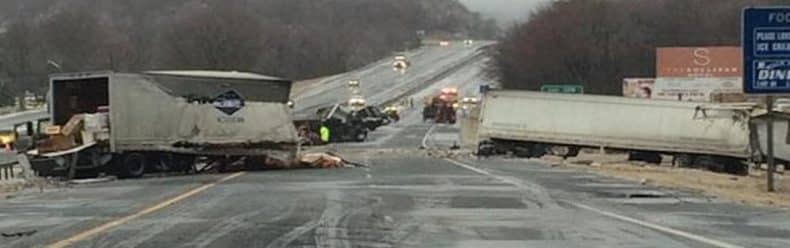
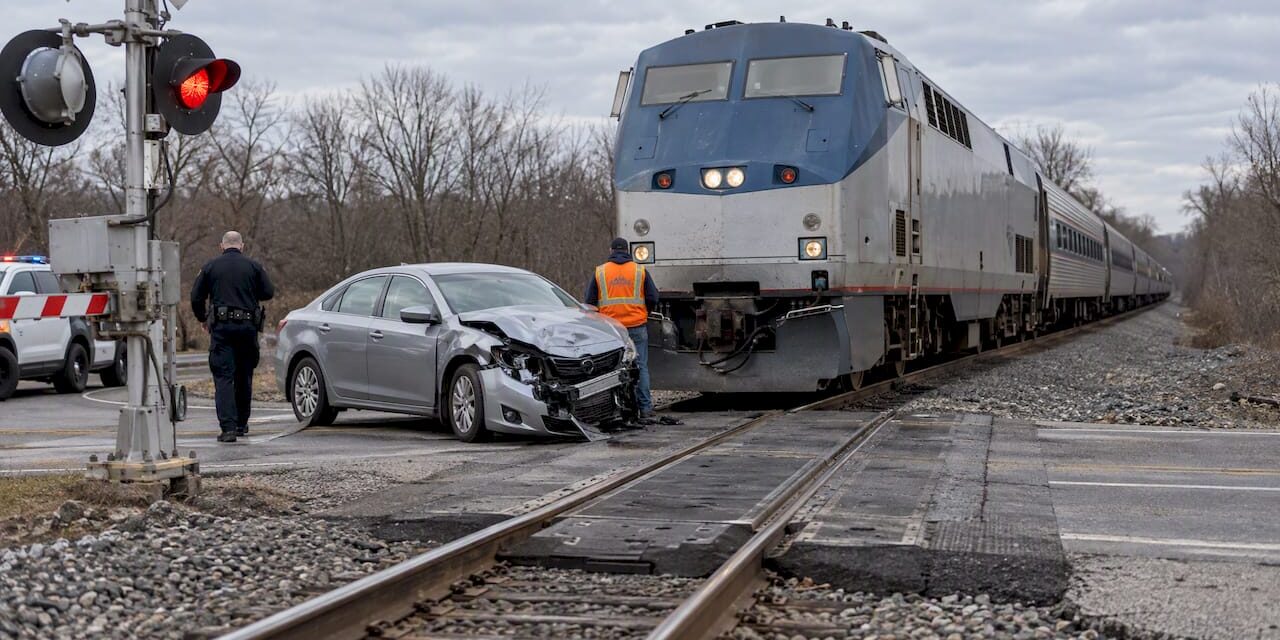
If you were hurt in a train or railroad accident, a train accident lawyer can identify who is legally responsible, preserve evidence the railroad controls, and pursue compensation for your medical care, lost income and long-term needs. Your claim depends on who you were when it happened. A passenger, a driver at a crossing, a pedestrian and a railroad employee each follow a different legal path, and the deadlines are short. This guide explains those paths, what to do in the first days, and what to look for when you choose an attorney.
TL;DR
- Railroad employees bring negligence claims under a federal law, FELA, not an ordinary workers’ compensation claim. Passengers, drivers and pedestrians bring injury claims against the railroad or other responsible parties.
- Train accidents rarely have one cause. Track, signals, crew decisions, equipment and company policy can all play a part, and the railroad holds much of the proof.
- Deadlines differ. Pennsylvania injury claims generally carry a two-year limit, while FELA claims carry three years under federal law.
- See a doctor right away, photograph what you can, and do not sign or give recorded statements to a railroad or insurer before speaking with a lawyer.
- We handle injury cases on a contingency basis: no fee unless we win your case.
Table of Contents
- What counts as a train accident claim
- Why train accidents happen
- Injuries that follow train accidents
- Who may be liable
- Railroad employees: FELA is not workers’ compensation
- Passengers: special rules for rail carriers
- What compensation can cover
- Deadlines you cannot ignore
- What to do after a train accident
- Perspective: what we see in railroad cases
- How we can help
- How to choose a train accident attorney
- FAQ
- Sources
What counts as a train accident claim
A train accident claim is a legal demand for compensation after a collision, derailment, crossing crash, platform fall, sudden-stop injury or worksite incident involving a train, a railcar or railroad property. The people who bring these claims fall into a few groups:
Passengers on intercity, commuter or transit trains injured in a crash, derailment, emergency braking event or unsafe station condition.
Motorists and pedestrians struck at a grade crossing or along the tracks.
Railroad employees such as conductors, engineers, brakemen, track workers and yard crews hurt on the job.
Families who have lost someone in any of these situations.
The group you belong to decides which law applies, who you can sue, and how fault is measured. That is why a general injury lawyer who has never dealt with a railroad can lose valuable time at the start.
Why train accidents happen
Railroads report accidents using a coding system, and the Federal Railroad Administration groups causes into tracks, roadbed and structures, signal and communication, human factors, mechanical and electrical failures, and miscellaneous factors. Each category points to a different defendant. A broken rail may implicate the company that maintains the track. A signal failure may point to the railroad or a contractor. A fatigued crew points to scheduling and staffing decisions.
Safety researchers add an important warning. Transportation Research Board material on railroad operational safety describes collisions as rarely the result of a single factor, but instead a web of human-factor issues, organizational decisions and system design flaws. For you, that means a claim built on the engineer’s mistake alone may leave real value on the table. A thorough investigation looks at the whole system behind the crash.
Federal oversight covers areas such as track inspection, passenger equipment, crew staffing, employee training, positive train control and grade-crossing safety. When a railroad breaks one of those safety rules, that violation can become the center of your case.
Injuries that follow train accidents
The forces involved are enormous, and the injuries are often catastrophic. A study of train-related trauma in the United States covering 1990 to 1995 found that 56% of patients had extremity fractures and 38% required amputations. Beyond fractures and amputations, we see the following in serious rail cases:
- Spinal cord injuries, including partial or complete paralysis, which can mean lifelong care, home modifications and loss of the ability to work.
- Traumatic brain injuries, from impact, whiplash-type motion or a fall inside a moving car.
- Crushing injuries, internal bleeding and organ damage.
- Severe burns, particularly when hazardous cargo or fire is involved.
- Psychological injuries, including post-traumatic stress after a violent crash.
If you are searching for a spinal injury attorney after a rail accident, the same principles apply: the claim must account for a lifetime of costs, not just the hospital bills in front of you. Spinal and brain injury cases often need a life care planner, a vocational expert and treating specialists to show what your future requires. Our catastrophic injury work is built around that kind of proof.
Some injuries do not announce themselves. Concussions and internal bleeding can show few symptoms at first, which is one more reason to get examined even if you feel able to walk away.
Who may be liable
Liability in a train case is rarely limited to one party. Depending on the facts, responsible parties can include:
The railroad or transit operator. For passengers, this includes carriers such as Amtrak and commuter operators. For employees, it is the employer.
The track or infrastructure owner. Many railroads run on track owned by another company, and the owner may be responsible for maintenance.
Equipment makers and repair contractors. A defective brake, coupling or locomotive component can create liability beyond the railroad. Our dangerous product practice covers claims of that kind.
Government entities. Crossing design, signage and roadway conditions may involve public agencies, which often have special notice rules and shorter timelines.
Other drivers or third parties. A truck stuck on the tracks, for example, can bring a commercial vehicle company into the case.
Federal law shapes these claims. One provision preserves state-law damages actions alleging that a railroad failed to follow federal standards, its own rules created under them, or compatible state law. In practice, a lawyer needs to know which federal safety rules were in play and whether the railroad followed them.
Crossing cases turn heavily on visibility. In one Oklahoma crossing case, the Tenth Circuit found that evidence on sight distance, train visibility and expert analysis created a real dispute over whether the driver could see the train and stop safely. That is the kind of detail that expert reconstruction can establish.
Railroad employees: FELA is not workers’ compensation
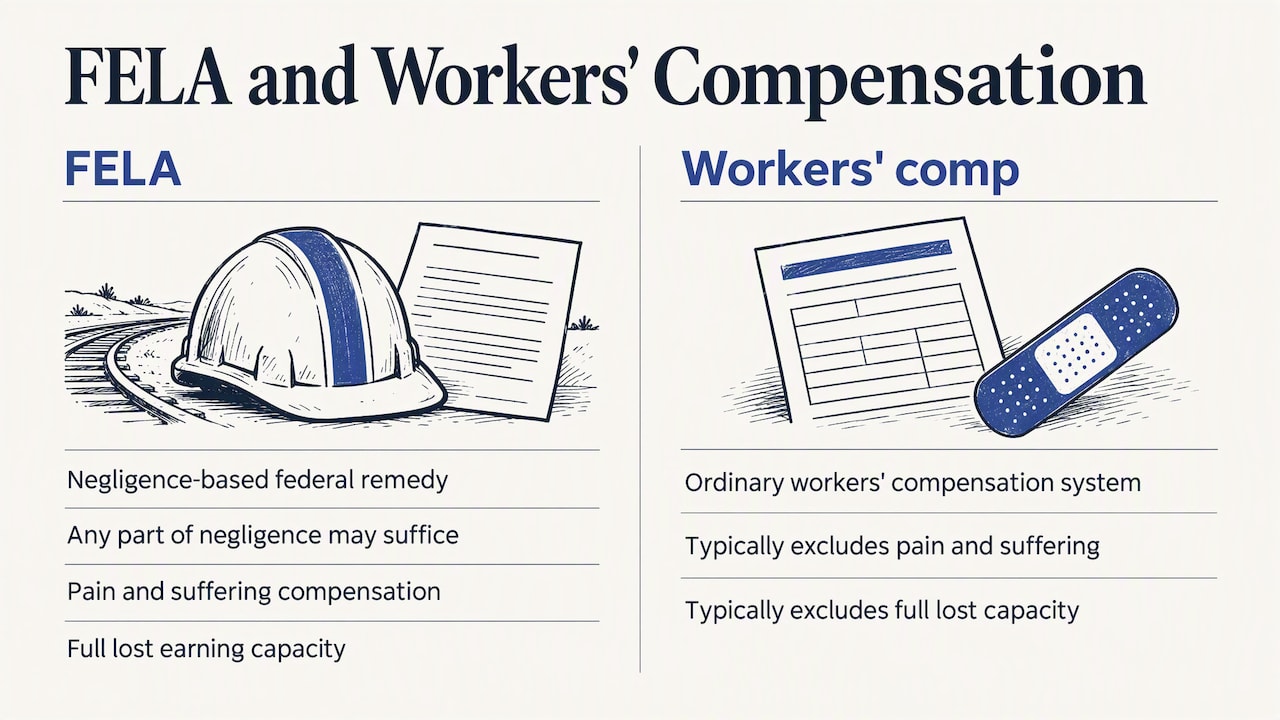
If you work for a railroad, you are not in the ordinary workers’ compensation system. The Federal Employers’ Liability Act gives railroad workers a negligence-based claim for on-the-job injuries, a federal remedy that preempts state tort law. By statute, an interstate railroad is liable for an employee’s injury or death resulting in whole or in part from the negligence of its officers, agents or employees, or from defective equipment.
That phrase, “in whole or in part,” matters. Under FELA, a court has said negligence need only have played any part, even the slightest, in producing the injury. The standard is friendlier to workers than ordinary negligence law, but it is not automatic benefits. You still have to connect the railroad’s negligence or a safety-rule violation to your injury, and the railroad’s claims department will work hard to break that link.
Because FELA pays based on proof of fault, it can lead to compensation for pain and suffering and full lost earning capacity, which a standard workers’ compensation system typically does not. It also means you should be careful about early recorded statements, company forms and quick settlement offers. Our page on railroad employee accidents explains how we approach these claims.
Passengers: special rules for rail carriers
Passenger claims against Amtrak and other rail operators have their own federal rules. Under 49 U.S.C. § 28103, punitive damages require clear and convincing evidence of conscious, flagrant indifference to the rights or safety of others, and aggregate awards for a single accident or incident may not exceed $200,000,000. The statute covers Amtrak, commuter authorities and operators, rail carriers, states and specified officers and employees.
That cap is a ceiling for the most extreme multi-victim events. It does not limit what compensatory damages may be recovered for medical bills, lost income and pain in the usual case. It does mean that in a major derailment with many injured passengers, early and organized legal action matters.
What compensation can cover
The damages in a train accident case are meant to cover the real cost of what happened to you:
Medical expenses, past and future, including surgery, rehabilitation, mobility equipment and home care.
Lost income and earning capacity, especially when you cannot return to your old job.
Pain, suffering and loss of enjoyment of life.
Wrongful death damages for families, including funeral costs and the loss of support and companionship. See our page on Pennsylvania wrongful death claims.
We do not promise any amount. The value of a case depends on the injuries, the proof of fault and the defendants involved.
Deadlines you cannot ignore
Time limits are one of the biggest traps in railroad cases. The right deadline depends on your role and your state.
For railroad employees, FELA sets the outer limit at three years: the federal statute on limitation of actions was changed from two years to three in 1939. For most Pennsylvania personal injury claims, the general limit is two years, which we explain on our page about Pennsylvania personal injury deadlines, fault and your rights. Wrongful death claims, minors and claims involving public agencies can follow different rules, and a government defendant may require a written notice much sooner than the lawsuit deadline.
Other states set their own limits, and a crash in another state can change the law that applies even if you live in Pennsylvania. Do not count on the longest possible deadline. Contact a lawyer early so that evidence is preserved while it still exists. Railroads are known to keep event recorder data, video and maintenance logs only for limited periods unless they receive a written preservation demand, so an early letter can matter more than the filing date.
What to do after a train accident
Steps in the first days shape the whole claim.
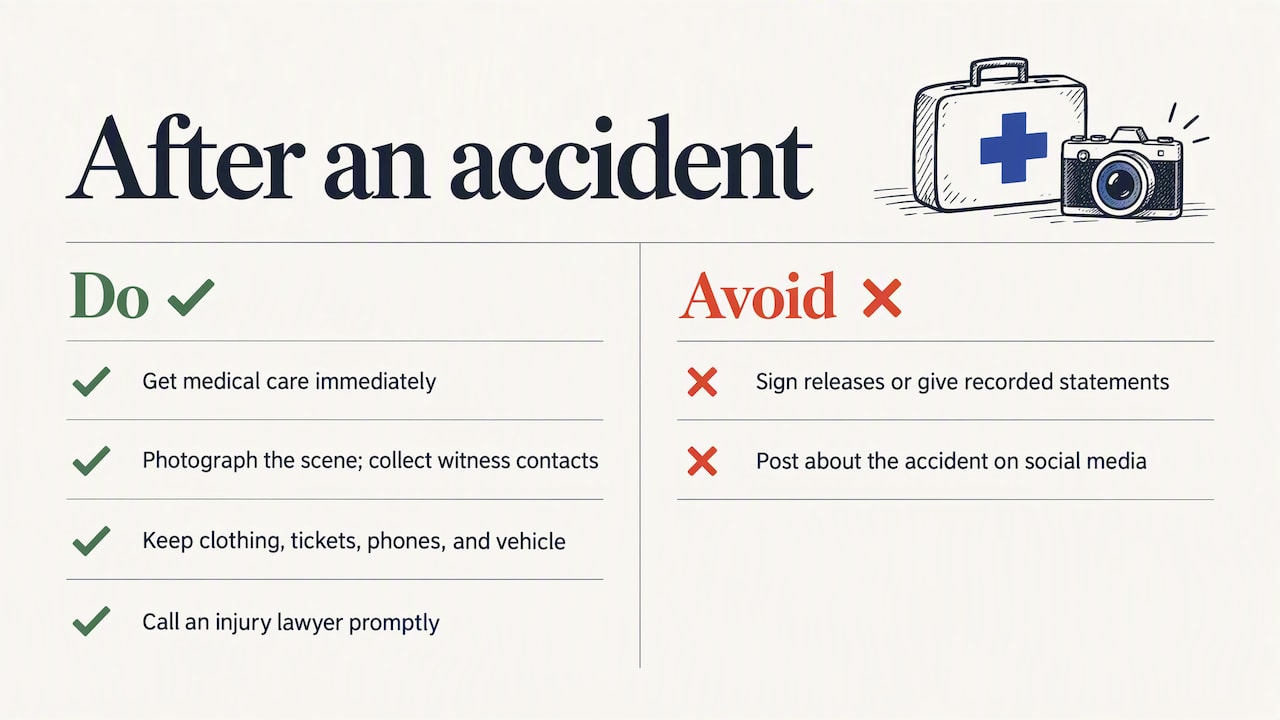
Get medical care immediately. Some serious injuries, such as concussions and internal bleeding, may not show obvious symptoms at first. A prompt record also ties your injuries to the accident.
Document the scene if you can. The National Transportation Safety Board’s guidance for those involved in transportation accidents lists photographing the scene and collecting witness contact information. Photograph the crossing, signals, vehicles, track conditions and your injuries.
Keep what you were wearing, carrying and riding in. Torn clothing, a ticket, a phone and a damaged vehicle are evidence.
Be careful with statements. Do not sign releases or give recorded statements to a railroad or its insurer before you have legal advice. Adjusters are trained to collect statements that narrow a claim.
Stay off social media. Posts can be read out of context and used to challenge how badly you were hurt.
Write down names. Record crew members, officers, bystanders and the train number, time and location.
Call a lawyer who handles injury cases against large companies. The sooner a preservation letter goes out, the better the chance that recorder data, camera footage and inspection records survive.
Perspective: what we see in railroad cases
We have represented injured people across Pennsylvania for more than 20 years, and the pattern in serious injury cases is consistent: the company that caused the harm moves fast, and the injured person is told to wait. We think that gets it backwards. The first days decide whether the black box data, the maintenance records and the witnesses are still available.
We also believe a railroad claim should be prepared as if it is going to trial. That means gathering the evidence ourselves, working with expert witnesses, and building a case the other side cannot dismiss as a quick settlement target. Railroad workers in particular deserve to know that FELA is a fault-based claim, not a benefits form, and that how you handle the first report and the first conversation with a claims agent matters.
And you should be able to reach your lawyer. Direct attorney access and availability when you need us are core to how we work, because a family dealing with a spinal injury or a death should not be passed between assistants.
— the author
How we can help
Pisanchyn Law Firm represents injured people throughout Pennsylvania, including Scranton, Wilkes-Barre, Harrisburg, Pittsburgh and Philadelphia. Our practice covers serious injury, catastrophic injury, wrongful death and claims involving railroad employees, with evidence gathering, negotiation, litigation and expert witness support. We work on a contingency basis, so you pay no fee unless we win your case.

If you or someone in your family was hurt in a rail accident, contact Pisanchyn Law Firm for a conversation about your options. Tell us what happened, and we will tell you plainly where you stand and what needs to be done first.
How to choose a train accident attorney
Train cases are not like car cases. Ask any lawyer you consider these questions:
Have you handled claims against large carriers? Railroads and their insurers have in-house investigators and lawyers ready within hours.
Will you send a preservation demand right away? Delay can cost you the best evidence.
Do you work with experts? Accident reconstruction, human factors, track engineering, medical and life care experts all matter in serious cases.
Who will I speak with? You should know which attorney is responsible for your file and how to reach that person.
How are fees handled? A contingency agreement should be explained in writing, including costs and the percentage.
FAQ
How much is a train accident case worth?
There is no standard figure. Value depends on the severity and permanence of your injuries, your medical costs, your lost earning capacity, the strength of the proof of fault and which defendants are involved. A lawyer can estimate a range only after reviewing your records and the accident evidence.
Do railroad employees file workers’ compensation after an injury?
Generally no. Employees of interstate railroads are covered by FELA, which requires proof that the railroad’s negligence played a part in the injury. Some workers, such as certain contractors, may fall under different rules, so the facts of your job matter.
How long do I have to file a train accident lawsuit?
FELA claims have a three-year federal limit, and most Pennsylvania personal injury claims have a two-year limit. Claims against government bodies, wrongful death claims and claims involving minors can differ, so speak with an attorney as early as you can.
What if I was partly at fault for the crash?
Fault does not always end a claim. Pennsylvania weighs the shares of fault in many injury cases, and FELA lets a railroad worker pursue a claim even when the railroad’s negligence was only part of the cause. An attorney can explain how your situation would be treated.
What does it cost to hire us?
We are paid only if we win or settle your case, through a contingency fee agreement. You pay no attorney fee up front.
Sources
- Train Accident Cause Codes, Federal Railroad Administration
- Railroad Operational Safety, Transportation Research Board
- Oversight of the Ongoing Rail, Pipeline, and Hazardous Materials Rulemakings
- Train accidents involving pedestrians, motor vehicles, and trains (PubMed)
- 49 U.S. Code § 20106, Preemption
- Tenth Circuit opinion, July 11, 2013
- Norfolk Southern R. Co. v. Sorrell
- 45 U.S. Code § 51, Liability of common carriers
- Eighth Circuit opinion on FELA negligence (2020)
- 49 U.S. Code § 28103, Limitations on rail passenger transportation liability
- 45 U.S. Code § 56, Actions; limitation
- Responding to a Transportation Accident, NTSB (2023)
- Steps to Take After a Train Accident, FindTheLawyers
Recommended
Created with BabyLoveGrowth, the AI SEO writer