
Full tort keeps your right to seek compensation for pain and suffering after a crash caused by another driver. Limited tort gives that right up in exchange for a lower premium, unless your injury counts as “serious” under Pennsylvania law or one of the statutory exceptions applies. Under both options you can still recover medical bills and other out-of-pocket losses. The difference shows up when you are hurt badly enough that those bills are only part of what you lost.
This guide explains both options in plain language, lists the exceptions that can restore your rights, and shows how to decide. If you were already hurt and are wondering which option you chose, jump to the section on checking your policy.
TL;DR
- Full tort lets you pursue pain and suffering and other non-economic damages with no injury threshold. Limited tort restricts that right unless your injury is “serious” or an exception applies.
- Your choice applies to you and the members of your household covered under the policy, not just the driver who signed.
- Even with limited tort, five kinds of situations can restore your full rights, such as an at-fault drunk driver or an at-fault vehicle registered in another state.
- You cannot change your election after a crash. If you never returned the form, your insurer treats your policy as full tort.
- Cheaper premiums are real, but so is the risk. Compare the yearly savings with what a serious injury could cost you.
Table of Contents
- What the two options actually mean
- What counts as a “serious injury”
- Exceptions that restore your full rights
- Who your choice affects
- Full tort or limited tort: how to decide
- You cannot choose after a crash
- Our perspective: limited tort looks cheap until it isn’t
- If you were hurt and have limited tort
- How we can help
- FAQ
- Sources
What the two options actually mean
Pennsylvania is a “choice” no-fault state. Whichever option you pick, your own policy’s medical benefits coverage pays your initial medical costs regardless of who caused the crash. The Triple-I overview of no-fault insurance explains the general idea: each driver turns first to their own insurer. Pennsylvania adds a second layer of choice on top, which is the tort option.
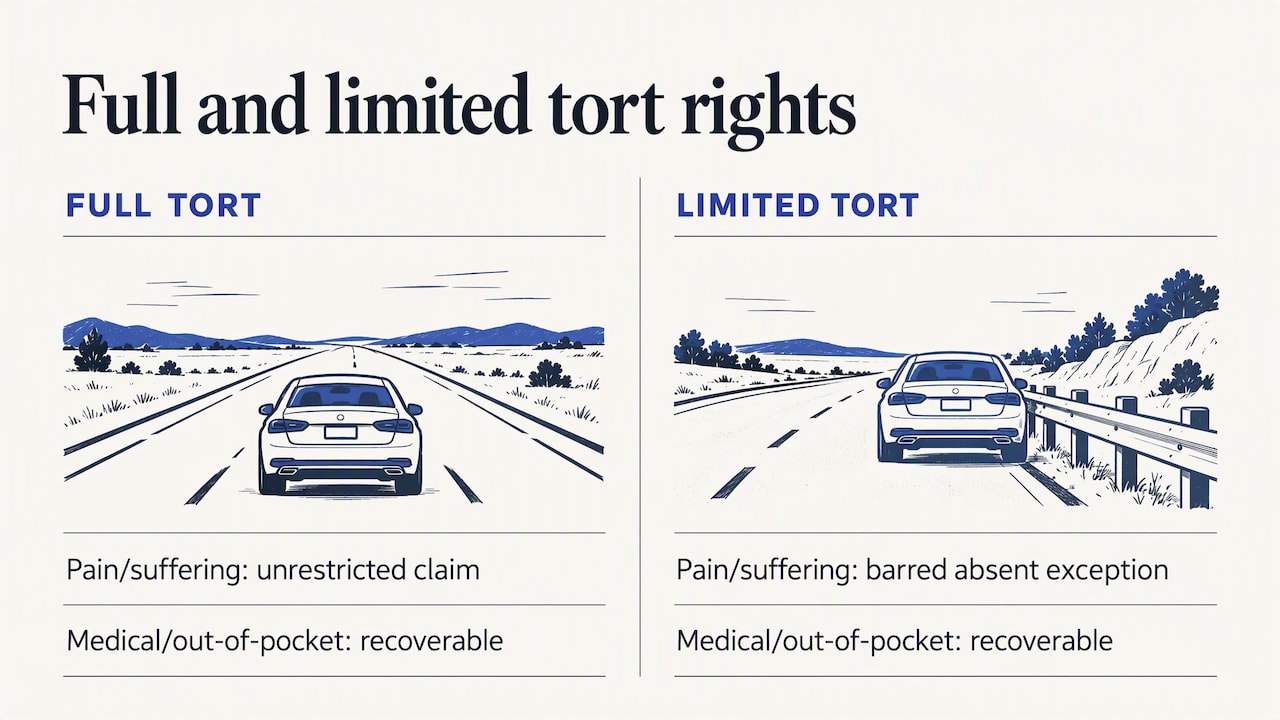
The wording comes from the state’s own notice. Under 75 Pa.C.S. § 1705, insurers must give you a form describing both options. The statutory notice says the limited tort option limits your right, and the right of your household members, to seek compensation for injuries caused by other drivers. You can still seek recovery for medical and other out-of-pocket expenses, but not for pain and suffering or other nonmonetary damages, unless the injury meets the “serious injury” definition or another exception applies. Under full tort, you keep an unrestricted right to seek those damages as well.
Full tort in practice
With full tort, you can bring a claim against the at-fault driver for:
- Medical expenses not covered by your own benefits
- Lost wages and lost earning ability
- Pain and suffering
- Loss of enjoyment of life and other non-economic harm
You still have to prove the other driver was at fault and show your damages. What you do not have to prove is that your injury crosses a legal threshold.
Limited tort in practice
With limited tort, you can still recover medical bills and lost income from the at-fault driver. The restriction falls on non-economic damages. Pennsylvania law defines “noneconomic loss” as pain and suffering and other nonmonetary losses. To claim them, you must show your injury is serious or that an exception applies. That adds a third question to every claim: not only who was at fault and what it cost, but also whether the injury qualifies.
| Full tort | Limited tort | |
|---|---|---|
| Medical bills and out-of-pocket costs | Can recover | Can recover |
| Lost wages | Can recover | Can recover |
| Pain and suffering | Can recover, no threshold | Only if the injury is “serious” or an exception applies |
| Premium | Higher | Lower |
| Who is bound | You and covered household members | You and covered household members |
| Default if you return nothing | Yes | No, you must sign and return the form |
What counts as a “serious injury”
The threshold comes from 75 Pa.C.S. § 1702. It defines a serious injury as death, serious impairment of body function, or permanent serious disfigurement. The statutory definitions are the starting point, but the middle phrase, “serious impairment of body function,” is where most disputes happen.
There is no checklist. Insurers and defense lawyers often argue that an injury is not serious enough, and courts decide case by case. In practice, the question tends to turn on how much the injury interferes with your daily life, how well that is documented, and whether it lasts. A broken bone that heals in a few months with no lasting effects is an argument you may have to make with strong medical records. Soft tissue injuries such as whiplash are the ones most often challenged.
Two practical points follow:
- A doctor’s note alone rarely settles it. Records that show how the injury changed your work, sleep, movement and routines carry more weight.
- The threshold is a hurdle for the injured person, not the insurer. Under limited tort, you carry the burden of showing your injury qualifies.
Exceptions that restore your full rights
Choosing limited tort does not always mean you are stuck with it. Section 1705(d) lists situations where you can seek full damages anyway. According to the text of the statute, these include when:
- The at-fault driver was convicted of, or accepted Accelerated Rehabilitative Disposition (ARD) for, driving under the influence
- The at-fault vehicle is registered in another state
- You were a passenger in a commercial vehicle, such as a taxi or bus, or you were on a motorcycle
- The at-fault driver was uninsured
If you were hurt in a rideshare, the situation may fit the passenger exception. See our page on Uber passenger injury claims for how those cases work. Motorcyclists can read more on our motorcycle accident attorneys page, and crashes involving trucks, delivery vans and buses are covered on our commercial vehicle accident page.
These exceptions have conditions of their own. Whether a DUI conviction or ARD has occurred, for example, may not be known until the criminal case ends. Do not assume an exception applies, and do not assume it does not. Have a lawyer read the facts.
Who your choice affects
The election does not belong to one person. The state’s notice says the limited tort option limits the rights of you and members of your household covered under the policy. That means a spouse, a teen driver or an adult child on the policy is bound by a choice they may never have made.
A few related situations come up often:
- Passengers in someone else’s car. Your rights are usually tied to the policy covering the vehicle you were riding in, not your own personal auto policy.
- People who do not own a car. If you are not a named insured on a policy, you are generally not subject to these restrictions and keep full tort rights.
- Pedestrians and cyclists. Whether the restriction applies depends on the policies that apply to you. This is worth a conversation with an attorney before you assume anything.
Full tort or limited tort: how to decide
The honest answer is that limited tort saves money in every year you do not need the right it gives up, and costs you dearly in the year you do. Insurance analysts often describe limited tort as a discount on your legal rights, not on your insurance protection. It lowers the premium, but it moves the financial risk of a serious injury from the at-fault driver’s insurer onto you and your own health coverage.
Ask yourself these questions:
- Who depends on me? If a spouse, children or aging parents rely on your income, a long recovery hurts them too.
- Could I afford to be out of work for months? Pain and suffering is not the only thing at stake. A threshold dispute can delay and reduce the whole claim.
- Who else is on my policy? Teen drivers and household members are bound too.
- What do I drive, and how far? A long daily commute increases exposure.
- How much would the savings be? Get both quotes from your insurer, with the same coverage limits, and compare the dollar figure to the risk. If you want to see how an independent broker thinks about premium savings against exposure, this guide to deciding what coverage is worth keeping is a useful companion, though it is written for a Minnesota agency and its rules differ from Pennsylvania’s.
The decision is yours and depends on your budget. But many drivers who pick limited tort never put an exact number on the savings. Ask your insurer for it before you renew.
You cannot choose after a crash
This is the most expensive misunderstanding. Your election is locked in when you buy or renew your policy. You cannot look at your injuries and then pick the option that suits them.
Insurers must also make the choice visible. Under 75 Pa.C.S. § 1791.1, the insurer must give you notice of the tort options when you apply for original coverage and at every renewal. Under § 1705, if you do not sign and return the limited tort notice, you are considered to have chosen full tort and are charged the full tort premium.
How to check which option you have
- Look at your declarations page. It should state the tort option.
- Find the signed selection form from your last application or renewal.
- If you cannot find either, call your insurer or agent and ask for a written copy of your election.
- Ask whether anyone else on the policy made changes, such as adding a driver or switching carriers.
- Keep a copy with your other insurance papers.
If an insurer claims you chose limited tort, ask to see the signed form. An election the insurer cannot document is worth challenging.
Our perspective: limited tort looks cheap until it isn’t
We have represented injured Pennsylvanians for more than 20 years. In our view, the tort choice is one of the least understood decisions on an auto policy, because almost nobody thinks about it until someone is hurt.
Here is what we see in serious cases. People with limited tort are often surprised that a painful injury, months of treatment and a long absence from work do not automatically clear the “serious injury” bar. The insurer will look for any reason to say they do not. That turns a claim about the other driver’s fault into a debate about how much you were hurt, and it happens while you are trying to heal.
Because of that, we prepare every case as if it may go to trial. That means gathering medical records, work history and testimony that show how the injury changed your life, not just the diagnosis. It matters most when the threshold is contested.
We also want to be clear about the other side. Limited tort is legal, and many people choose it on a tight budget. If you did, you are not out of options. Exceptions exist, and many injuries do meet the standard. What we ask is that you decide with the numbers in front of you, and that you talk to a lawyer early after a crash instead of guessing.
— Brian
If you were hurt and have limited tort
Take these steps, in this order:
- Get medical care and follow it. Gaps in treatment give insurers an argument that the injury is minor.
- Report the crash and call the police so there is an official record, including whether the other driver was impaired or uninsured.
- Do not give a recorded statement or sign a release before you know which tort option applies to you.
- Write down how the injury affects you. Missed work, tasks you cannot do, sleep, pain levels and relationships all matter to a “serious impairment” argument.
- Gather your policy documents, including the tort selection form.
- Talk to an attorney before accepting any offer. A quick settlement can close the door on damages you did not know you had.
If the crash happened at work, such as a delivery driver hit on the job, a separate workers’ compensation claim may also be involved. Our Pittsburgh and Harrisburg car accident pages explain how we approach local cases.
How we can help
Pisanchyn Law Firm handles car, truck, motorcycle and catastrophic injury claims across Pennsylvania from offices in Scranton, Pittsburgh and Harrisburg. We work on a contingency basis: you pay no legal fees unless we win your case. We have recovered more than $100 million in settlements for clients, and we prepare each case as though it may go to trial.
If you are not sure whether limited tort, full tort or an exception applies to you, we can read your policy and the crash facts and explain where you stand. Start with our car accident lawyers page or visit pisanchynlawfirm.com to reach us.
FAQ
Can I sue with limited tort in Pennsylvania?
Yes. You can still claim medical bills, lost wages and other out-of-pocket costs from an at-fault driver. To pursue pain and suffering, your injury must meet the serious injury definition, or an exception such as an uninsured or drunk at-fault driver must apply.
Is full tort worth paying for?
For many drivers it is, especially those with dependents, a long commute or limited savings. The extra premium is usually modest compared with the damages at stake after a serious injury. Ask your insurer for both quotes so you can see the real difference on your policy.
What happens if I never returned the tort selection form?
You are treated as having chosen full tort, and you are charged the full tort premium. The law puts the burden on you to sign and return the form if you want limited tort. If an insurer says you chose limited tort, ask for the signed form.
Can I switch from limited tort to full tort after an accident?
No. The election is set when you buy or renew a policy and cannot be changed to fit your injuries after a crash. You can change it at your next renewal, or sooner by contacting your insurer. Any change affects only future accidents.
Does my choice apply to my family?
Yes. The election applies to you and the household members covered under your policy. A spouse or teen driver on your policy is bound by the option you selected, so discuss it with them before you renew.
Sources
- 75 Pa.C.S. § 1705, Election of tort options (Justia)
- Section 1705.0 notice of tort options (Pennsylvania General Assembly)
- 75 Pa.C.S. § 1702, Definitions (Pennsylvania General Assembly)
- 75 Pa.C.S. § 1791.1, Notice of tort options (Pennsylvania General Assembly)
- Background on no-fault auto insurance (Triple-I)
- Pennsylvania auto insurance: full tort vs. limited tort (InsuranceClarify)
Recommended
- Harrisburg Catastrophic Injury Lawyers
- Scranton Catastrophic Injury Lawyers
- Harrisburg Car Accident Lawyers
- Pittsburgh Car Accident Lawyers