

If you were hurt at work in Philadelphia, a workers’ compensation lawyer handles the parts of your claim that insurers use against injured people: the notice deadlines, the claim petition, the medical disputes and the hearings before a Workers’ Compensation Judge. You can file without counsel, but a denial, a cutoff of benefits or a lowball settlement is where representation matters most. At Pisanchyn Law Firm, we fight for injured Pennsylvania workers, and you pay no fee unless we win or settle your case.
TL;DR
- Report your injury to your employer right away. Pennsylvania sets a 21-day notice window to protect retroactive benefits and a hard outer limit of 120 days.
- Benefits can include medical care, wage-loss payments and death benefits for dependents.
- If the insurer denies your claim, you can file a claim petition and have a hearing before a Workers’ Compensation Judge.
- Any attorney fee in a Pennsylvania workers’ comp case must be approved by a judge or the Appeal Board.
- Appeals of a judge’s decision must be filed within 20 calendar days.
Table of Contents
- What a Philadelphia workers’ comp lawyer does for you
- Who is covered and what benefits you can get
- Reporting your injury: the first steps
- Filing a claim petition
- If your claim is denied or your benefits stop
- How attorney fees work
- Choosing a lawyer in Philadelphia
- Talk to us about your claim
- FAQ
- Sources
What a Philadelphia workers’ comp lawyer does for you
A good workers’ comp attorney does more than fill out forms. We build the claim from the first day, and we stay on it until the benefits are secured.
In practice, that means we help you report the injury properly, so the insurer cannot later say it was never work-related. We gather medical records and keep your treatment documented. We prepare the claim petition when benefits are denied, and we stand beside you at hearings. When the insurer sends you for an Independent Medical Examination, or the other side tries to terminate your benefits, we respond with evidence instead of leaving real value on the table.
We also advise on settlement. A Compromise and Release can close your claim for a lump sum, but it usually ends your right to future benefits too. We go through what your injury may cost over the long run before you decide.
Who is covered and what benefits you can get
Most Pennsylvania workers, including part-time and seasonal employees, are covered, though some exemptions and federal systems apply to certain jobs. According to the Department of Labor and Industry’s injured worker pamphlet, the Act generally provides:
Medical care
Reasonable and necessary treatment for a work injury or illness.
Wage-loss benefits
Payments when you cannot work, whether the disability is total or partial.
Death and specific-loss benefits
Dependents can receive death benefits, and qualifying permanent loss or disfigurement can bring a specific-loss award. If you lost a family member in a workplace accident, our wrongful death attorneys can explain every route open to your family.
State guidance says that when disability lasts more than seven days, wage-loss benefits generally begin within 21 days of the employer’s notice, unless the claim is denied in that time.
Reporting your injury: the first steps
Tell a supervisor, manager or other employer representative as soon as possible. The state says you can do it verbally or in writing, and you should include what happened and where. Put it in writing if you can, so there is a record.
The same state page explains the deadlines. Notice within 21 days preserves retroactive benefits unless your employer already knew about the injury. Notice later than 120 days can cost you compensation. Our guide on what to do if you’re injured at work in Pennsylvania covers what to say, and not say, to the insurer.
See a doctor promptly and tell them the injury happened at work. Keep every record, pay stub and message about the injury.
Filing a claim petition
If the insurer rejects your claim, or you hear nothing 21 days after reporting, the Commonwealth says to file a claim petition with the Office of Adjudication through WCAIS. The petition needs the injury, its date, your wages and your lost income. The state notes you may file without a lawyer, but that counsel can reduce technical errors and omissions, and those errors are where claims quietly fail.
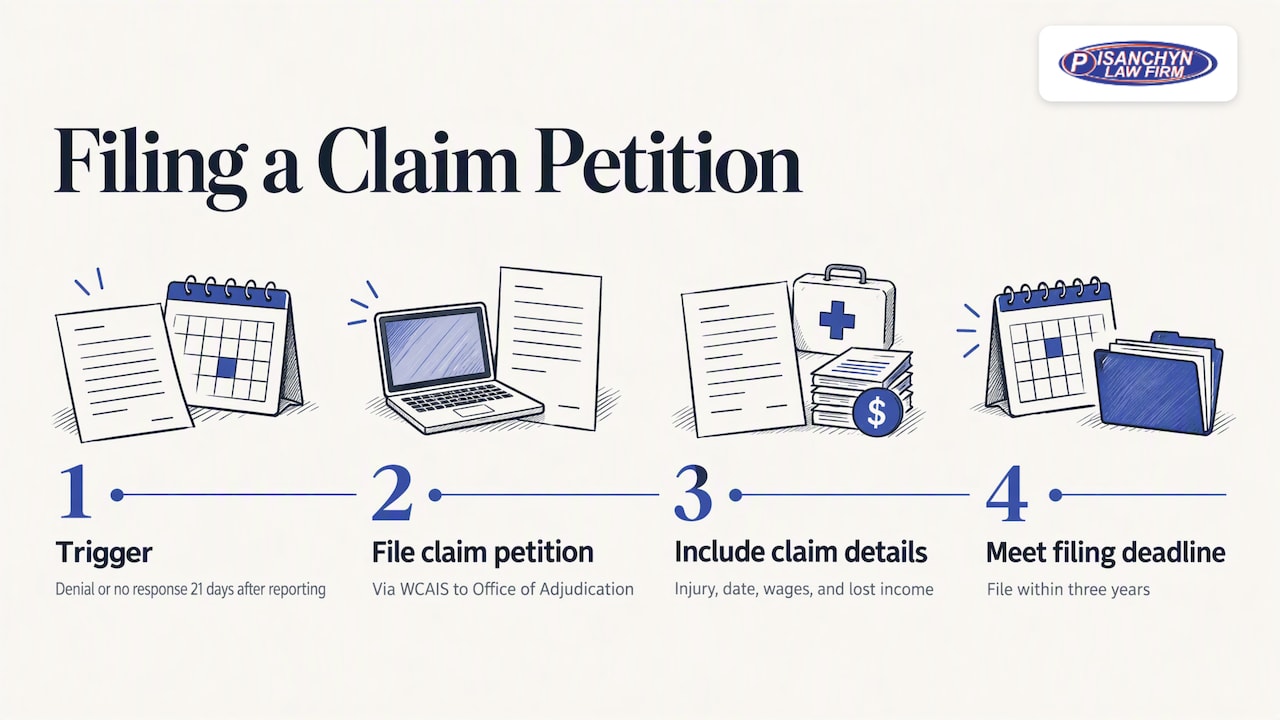
The overall time limit matters too. A claim petition for denied benefits must be filed within three years, according to the state pamphlet. Waiting costs you evidence, even when time remains.
If your claim is denied or your benefits stop
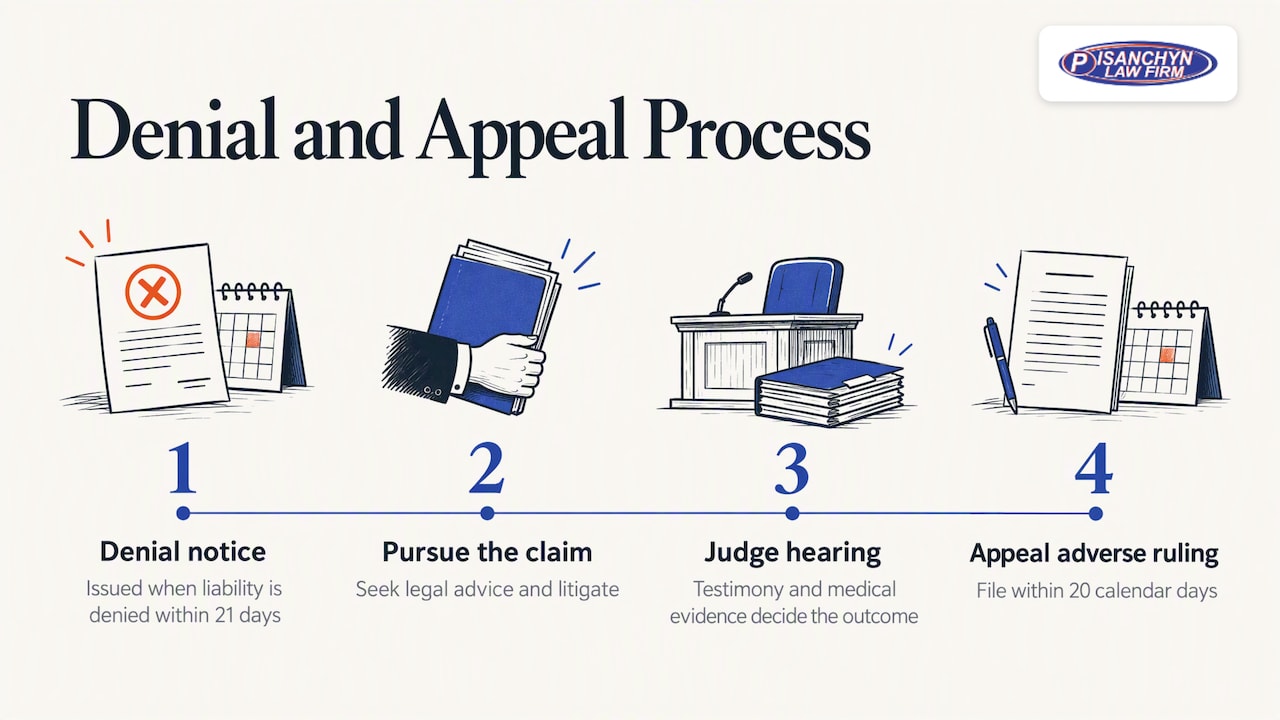
An insurer that denies liability within 21 days issues a Notice of Workers’ Compensation Denial. According to the Commonwealth’s claim flow chart, that is the point where the worker may seek legal advice and pursue the claim through litigation.
A denial is not the end. You can have your case heard by a Workers’ Compensation Judge, where testimony and medical evidence decide the outcome. If the judge rules against you, the Appeal Board says you have 20 calendar days from circulation of the decision to file a Notice of Appeal. That is short, and it is one reason to have a lawyer before the hearing, not after.
We explain the most common reasons for denial in our article on why workers’ comp claims get denied in Pennsylvania. Insurers may also use surveillance against you, which we cover on our workers’ compensation surveillance page.
How attorney fees work
Pennsylvania does not let a workers’ comp fee agreement operate on its own. The state pamphlet says the agreement must be approved by a Workers’ Compensation Judge or the Appeal Board, and it advises discussing fees and costs with your attorney before you hire one. Ask for the terms in writing and ask what costs you could owe.
At our firm, you pay no fee unless we win or settle your case.
Choosing a lawyer in Philadelphia
Ask any firm you consider these questions:
Will I speak with my attorney directly?
Direct access is part of how we work. You should know who is handling your file and be able to reach them.
Does the firm handle your type of job?
We represent injured workers in many settings, including office workers, warehouse workers, union members and state employees.
Will the case be prepared for a hearing?
Insurers settle better when they know the file is ready for a judge. Each of our cases is prepared with a strategy built around the client.
Talk to us about your claim
Pisanchyn Law Firm has more than 20 years of experience representing injured people across Pennsylvania, with workers’ compensation among our core practice areas. If your claim was denied, delayed or cut off, we will review it with you at no cost to start.

See our Pennsylvania workers’ compensation and personal injury services and contact us to speak with an attorney.
FAQ
Do I need a lawyer for a workers’ comp claim in Philadelphia?
The state says you may file without one. But a lawyer can reduce technical errors, and representation matters most if the claim is denied, benefits stop or you are offered a settlement. A free consultation costs you nothing.
How long do I have to report a work injury?
Give notice within 21 days to protect retroactive benefits, unless your employer already knew. Notice later than 120 days can cost you compensation. Report as soon as you can.
What if my employer denies the injury happened at work?
The insurer will issue a Notice of Workers’ Compensation Denial. You can then file a claim petition and present your case to a Workers’ Compensation Judge, ideally with an attorney.
How much does a workers’ comp lawyer cost?
Fees must be approved by a judge or the Appeal Board. Our firm charges nothing unless you win or settle. Ask any lawyer to explain fees and costs before you sign.
Sources
- LIBC-100 WC & The Injured Worker Pamphlet, PA Department of Labor and Industry
- LIBC-200 Employer Information, PA Department of Labor and Industry
- Report an Employee Injured on the Job, Commonwealth of Pennsylvania
- File a Workers’ Compensation Claim Petition, Commonwealth of Pennsylvania
- Flow of a Workers’ Compensation Claim, PA Department of Labor and Industry
- Workers’ Compensation Appeal Board, PA Department of Labor and Industry
Recommended
- Why is having a Workers’ Compensation lawyer important?
- Harrisburg Workers’ Compensation Lawyers
- What to Do If You’re Injured at Work in Pennsylvania (Before You Talk to Insurance)
- Pittsburgh Workers’ Compensation Lawyers