

A workers’ comp settlement is a written agreement in which you give up some or all of your workers’ compensation rights in exchange for a set payment. In Pennsylvania, the most common version is called a Compromise and Release, and it only takes effect after a Workers’ Compensation Judge approves it. Once it is approved, you generally cannot reopen what it settled. Know what you are giving up before you sign.
TL;DR
- A settlement trades future benefits for a payment now. Depending on the terms, it can cover wage loss, medical care, vocational rehabilitation, penalties, interest and fees.
- In Pennsylvania, a Compromise and Release can resolve any and all liability claimed under the Act, but only with a judge’s approval after a hearing.
- The amount depends on your disability rating, your average weekly wage, your future medical needs and how strong your claim is. There is no single average.
- You do not have to accept the first offer. You can reject it, take time, get a second medical opinion or counter with a specific number.
Table of Contents
- What a workers’ comp settlement actually is
- What you give up when you settle
- How settlement amounts are determined
- Why the amount on the check is not the amount you keep
- Do you have to accept the first offer?
- The approval step: a judge has the final say
- When a workers’ comp settlement attorney makes a difference
- Talk to us before you sign anything
- FAQ
- Sources
What a workers’ comp settlement actually is
In plain terms, the insurance carrier pays you a fixed amount and you agree to end part or all of your claim. Minnesota’s labor department describes it as a written agreement in which the employee gives up specified past or future benefits for a stated payment. The agreement can resolve wage-loss and permanent-disability benefits, medical care, vocational rehabilitation, penalties or interest, and fees.
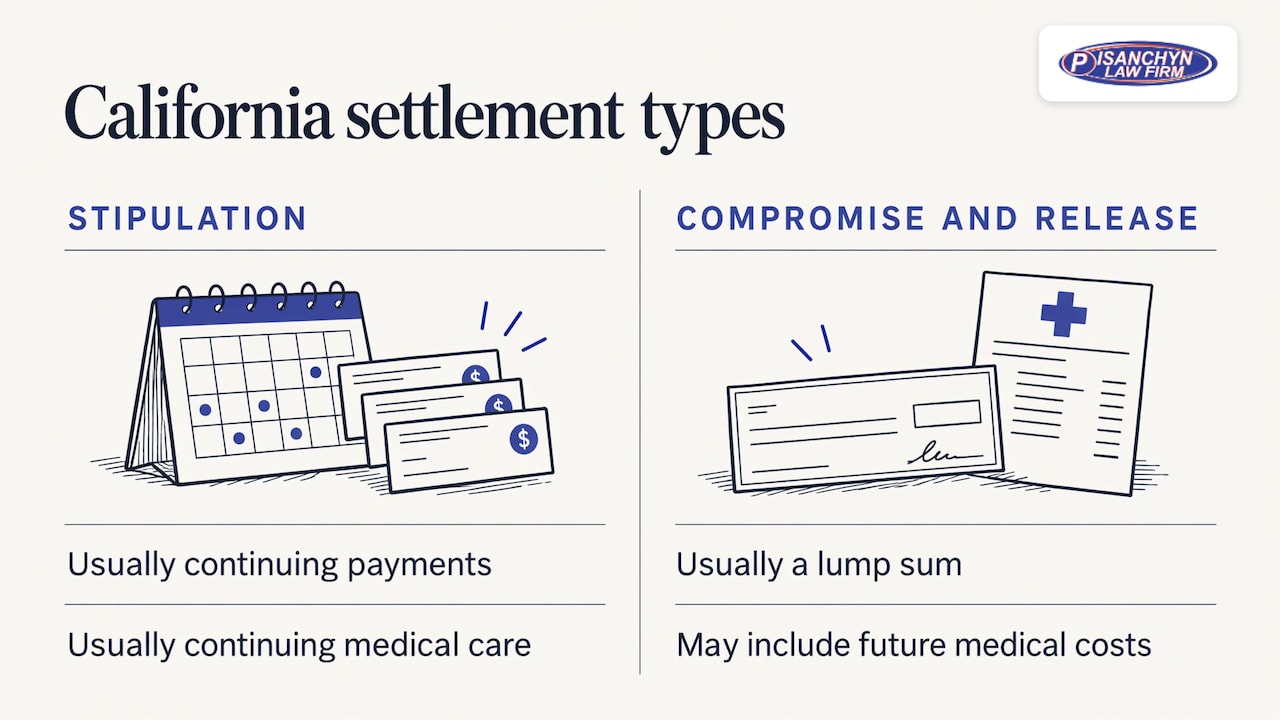
The details differ from state to state, but the pattern is the same everywhere: a lump sum or periodic payments in return for closure. California, for example, separates a Stipulation with Request for Award from a Compromise and Release. The first usually involves continuing payments and medical care. The second usually involves a lump sum that may include estimated future medical costs.
Pennsylvania uses the Compromise and Release. Under the state’s regulations, the parties may compromise upon or after filing a petition, and the proposed agreement is recorded on a form prescribed by the Department of Labor and Industry.
What you give up when you settle
This is the part that matters most. Missouri’s labor department warns that a settlement closes the case completely, including the insurer’s responsibility for more compensation and medical treatment, unless the written agreement preserves specific future medical benefits. Idaho’s Industrial Commission says the same thing in different words: settlements usually close benefits permanently, though some benefits, often medical, can be left open.
In practice, that means you need an honest answer to one question before you agree to anything: what will my medical care cost over the next ten, twenty or thirty years? If surgery, injections, therapy or medication are likely, a number that looks large today can leave real value on the table.
In a Compromise and Release that covers everything, you take on those future costs yourself. Your attorney should walk you through this line by line, so you know whether your medical treatment stays open or closes.
How settlement amounts are determined
No calculator gives you the right number, because the amount depends on several things at once. Missouri’s agency says amounts rest on the severity of the case, the degree of disability, doctors’ ratings and your average weekly compensation rate. Minnesota adds that evaluation may weigh future medical treatment, employment prospects, vocational rehabilitation and disputes over entitlement.
Many states calculate permanent-disability benefits with a formula. ProPublica explains the method: an impairment rating, the number of statutory weeks assigned to the body part, and a wage-based rate up to the state maximum. Its New York example shows a worker with a 10% arm impairment receiving $25,229.88 under that formula. That is one state’s formula, not Pennsylvania’s, but it shows why the same injury can be worth very different amounts depending on wages and rating.
Three factors move the number most in real cases:
Your impairment rating. Offers are often built on the rating from a doctor the insurer chose. Missouri notes that when that rating looks wrong, you can seek an independent medical evaluation, although you may have to pay for it. Insurers also schedule Independent Medical Examinations of their own, and what those doctors write can shape the entire negotiation.
Your future medical needs. The more care you are likely to need, the more the medical side of the settlement is worth, and the more dangerous it is to close it out cheaply.
Your ability to return to work. If your restrictions limit your job prospects, your wage-loss picture changes. That is leverage in a negotiation.
Why the amount on the check is not the amount you keep
The gross settlement figure and your take-home are different numbers. Minnesota’s labor department notes that attorney fees are generally deducted from benefits obtained for the worker, and litigation costs can include medical records, reports and deposition transcripts. The settlement can also address unpaid medical bills and reimbursements owed to others.
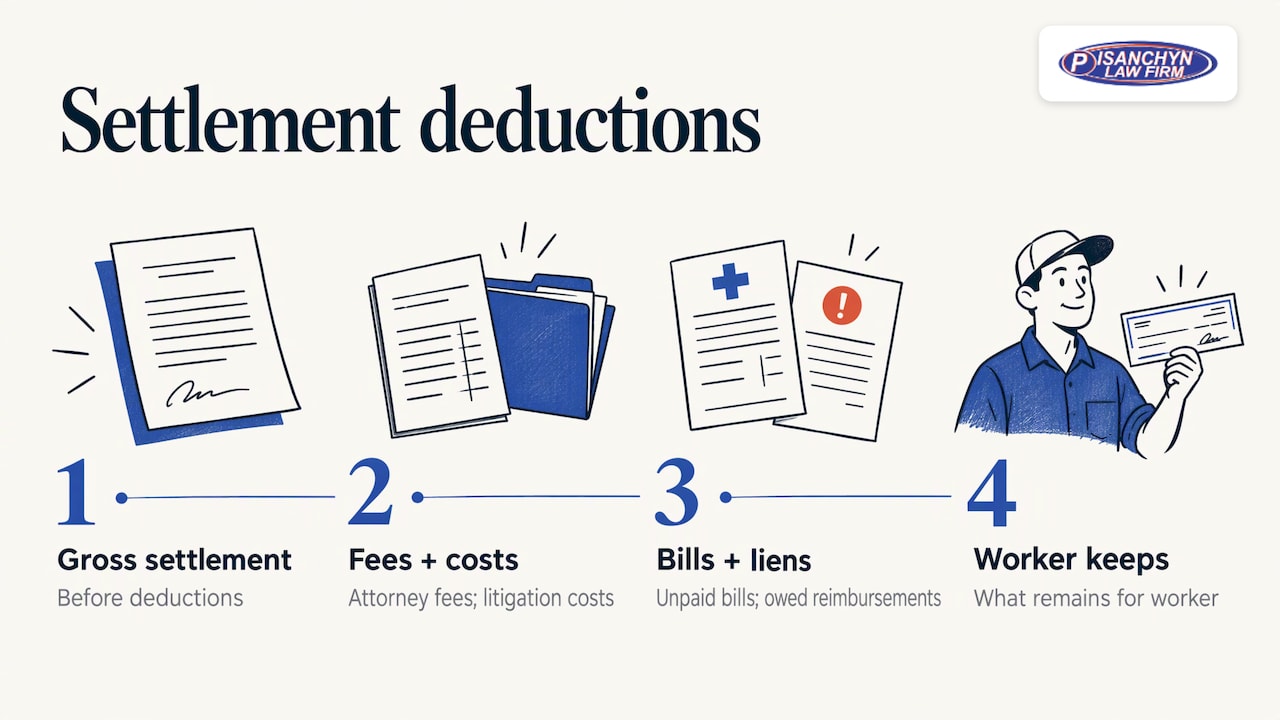
So before you compare any offer to your expectations, ask for a written breakdown: the gross amount, the attorney fee, case costs, any medical bills or liens to be paid out of it, and what is left for you. At Pisanchyn Law Firm, we handle workers’ compensation cases on a contingency basis. You pay no fee unless a settlement is achieved.
Do you have to accept the first offer?
No. Missouri’s guidance says you need not accept an offer immediately and that you may defer it, seek a second opinion or negotiate a different amount. The agency also recommends naming a specific dollar figure rather than asking for what is fair. A concrete demand, backed by medical records, wage records and a clear estimate of future care, gives the other side something to answer.
Before you decide, weigh these questions:
- Does the offer cover your lost wages, medical and travel expenses, and your ongoing medical needs?
- Are your work limitations reflected?
- Is your average weekly wage calculated correctly?
- How will the settlement affect any other benefits you receive?
Those are the points Missouri’s agency tells workers to consider. If the number feels low, our guides on what to do if you don’t like a settlement offer and what happens if you reject one explain your options.
The approval step: a judge has the final say
A settlement is not final because you and the insurer agree. Pennsylvania’s rules make a Compromise and Release subject to approval by the judge after a hearing. Other states follow a similar path. Colorado, for instance, requires that a written settlement be reviewed with the worker and approved in writing by an administrative law judge or division director.
The hearing is your chance to confirm that you understand what you are signing. Come prepared to answer questions about your injury, your treatment and whether the agreement reflects your understanding.
Timing varies widely, and it depends on how soon your medical condition stabilizes and how contested the claim is. We explain the usual timeline in how long workers’ comp takes to settle in PA.
When a workers’ comp settlement attorney makes a difference
You can legally settle without a lawyer. But a settlement is a one-time decision, and the insurer’s adjuster does this every day. California’s official guide says an attorney can protect your rights, develop case strategy, gather supporting information, track deadlines and represent you at hearings. It suggests considering counsel when benefits are withheld, when you have a permanent impairment, or when you are unsure how to proceed.
Those situations come up constantly in Pennsylvania. A denied claim, a benefit suspension after an insurer-chosen medical exam, or a pressured offer all call for someone on your side. Read more about why having a workers’ compensation lawyer matters and what our aggressive approach to workers’ comp looks like in practice.
If your claim was denied, start with our page on denied workers’ comp claims. A denial is often a negotiation position, not the end of the road.
Talk to us before you sign anything
Pisanchyn Law Firm has represented injured people across Pennsylvania for more than 20 years, including in Scranton, Wilkes-Barre, Harrisburg, Pittsburgh and Philadelphia. We give you direct attorney access, prepare each case around your facts and fight for the full value of your claim. You owe no fee unless we win a settlement for you.

If you have an offer in hand, or the insurer is pushing you toward one, contact our workers’ compensation attorneys before you respond. Whether you work in an office or a warehouse, we will review the offer with you and explain what it does and does not cover.
FAQ
What is a reasonable workers’ comp settlement offer?
A reasonable offer reflects your wage loss, medical expenses, future medical needs, work restrictions and a correct average weekly wage. Those are the factors Missouri’s labor department tells workers to weigh. If the offer rests only on the insurer’s doctor’s rating, have an attorney check it.
Can I reopen my case after I settle?
Generally, no. Agencies in Missouri and Idaho say a settlement typically closes the benefits it covers, unless the agreement keeps certain benefits, such as medical care, open. Ask exactly which benefits stay open before you sign.
Does every workers’ comp case end in a settlement?
No. Settlement is voluntary and requires approval. You can decline an offer, defer it or negotiate. Some claims continue as ongoing benefits, and others are resolved by a judge’s decision.
How much of a $20,000 settlement would I receive?
It depends on the attorney fee, case costs and any medical bills or reimbursements paid from the settlement. Minnesota’s labor department notes these are generally deducted. Ask for a written breakdown of every deduction before you agree.
Sources
- 34 Pa. Code § 131.57, Compromise and release agreements
- Minnesota Department of Labor and Industry, Workers’ compensation settlements
- California Division of Workers’ Compensation, Case resolved
- Idaho Industrial Commission, Settlement Agreement FAQs
- Missouri Department of Labor, Settling a Case
- Missouri Department of Labor, How is the settlement figured?
- ProPublica, Methodology for Workers’ Comp Benefits
- Colorado Revised Statutes 8-43-204
- California, Workers’ Compensation Guidebook for Injured Workers, attorney FAQ
Recommended
- How Long Does Workers’ Comp Take to Settle in PA?
- Denied Workers’ Comp Claim? Here’s How Our Attorneys Can Help
- Why is having a Workers’ Compensation lawyer important?
- Pennsylvania Workers’ Compensation Lawyer | Confidential Settlements