
If a driver hit you while you were on foot, a pedestrian accident lawyer investigates the crash, proves who was at fault, deals with the insurance companies and fights for the full value of your losses. In Pennsylvania you generally have two years to file a lawsuit, and fault is shared under a modified comparative rule. The steps you take in the first days shape what your claim can become.
TL;DR
- Get medical care right away, call the police and document the scene. Insurers often assume you were not badly hurt if you delay treatment.
- A pedestrian claim rests on four things: duty, breach, causation and damages.
- Pennsylvania generally gives you two years to sue, and shorter notice periods can apply if a government body is involved.
- If you share some fault, your compensation can be reduced. Do not discuss fault with the driver or an adjuster.
- At Pisanchyn Law Firm you pay no fee unless we win a settlement or award.
Table of Contents
- What a pedestrian accident lawyer does for you
- What to do in the first hours after being hit
- How fault is proven in a pedestrian claim
- Shared fault and Pennsylvania’s comparative rule
- What compensation can cover
- Deadlines you cannot miss
- How lawyer fees work
- Work with a Pennsylvania pedestrian injury team
- FAQ
- Sources
What a pedestrian accident lawyer does for you
A pedestrian is the most exposed person on the road. The injuries are often severe: fractures, head and spinal injuries, and long recoveries. The insurance company on the other side knows that, and it moves fast to limit what it pays.
Your attorney’s work usually falls into five jobs:
- Investigating the crash. Collecting the police report, witness statements, video, photographs and vehicle data before they disappear.
- Proving fault. Showing that the driver owed you a duty of care, breached it, and caused your injuries.
- Valuing your losses. Working with your doctors, and with experts where needed, to measure current and future medical needs and lost income.
- Handling the insurers. Taking over calls, recorded statements and demand letters so you can focus on recovery.
- Negotiating, then litigating if needed. Settling when the offer is fair and filing suit when it is not.
At our firm, each case is prepared with a strategy built around the client, and you have direct access to your attorney. You can read more about how we handle these claims on our pedestrian accident attorneys page.
What to do in the first hours after being hit
The actions you take right after the crash protect both your health and your claim. According to Nolo’s guide for pedestrians hit by a car, you should:
- call 911 if you need immediate medical attention;
- exchange contact and insurance information with the driver and vehicle owner;
- avoid discussing who caused the crash or what legal options exist;
- have police come to the scene and write a report;
- photograph the scene, your injuries and the vehicle damage;
- get names and contact details for witnesses;
- notify your own insurer if you have car insurance.
See a doctor even if the pain seems minor. The emergency room is usually the best choice, and at the least you should contact your primary care provider quickly. Adjusters and juries tend to assume that someone who did not seek care right away was not hurt much.
Our own guides cover the same ground in more detail: what to do immediately after an accident and what to do if you are injured in a car accident.
How fault is proven in a pedestrian claim
A pedestrian claim is a negligence claim. Justia’s overview of pedestrian accident law explains that you generally must show duty, breach, causation and damages. Examples of breach include speeding, distraction and failing to yield.
The evidence that carries those four elements is usually:
- the police report;
- witness testimony;
- photos and video of the scene, your injuries and the vehicle;
- medical records showing your diagnosis, treatment and costs.
Pennsylvania law gives drivers a specific duty. Under 75 Pa.C.S. § 3542, when no traffic signal is working, a driver must yield to a pedestrian in a marked crosswalk or in an unmarked crosswalk at an intersection. A pedestrian crossing elsewhere is not automatically without rights, but the question of who yielded to whom becomes more contested. That is where early investigation matters.
Some crashes also turn on conditions, such as rain, fog, glare or darkness. When weather is in dispute, a qualified expert can reconstruct what conditions were at the time. Forensic meteorology services are one example of the specialized evidence that can be brought into a claim.
Shared fault and Pennsylvania’s comparative rule
Insurers often argue that the pedestrian was partly to blame: crossing mid-block, looking at a phone, wearing dark clothing. This matters because of how fault is divided.
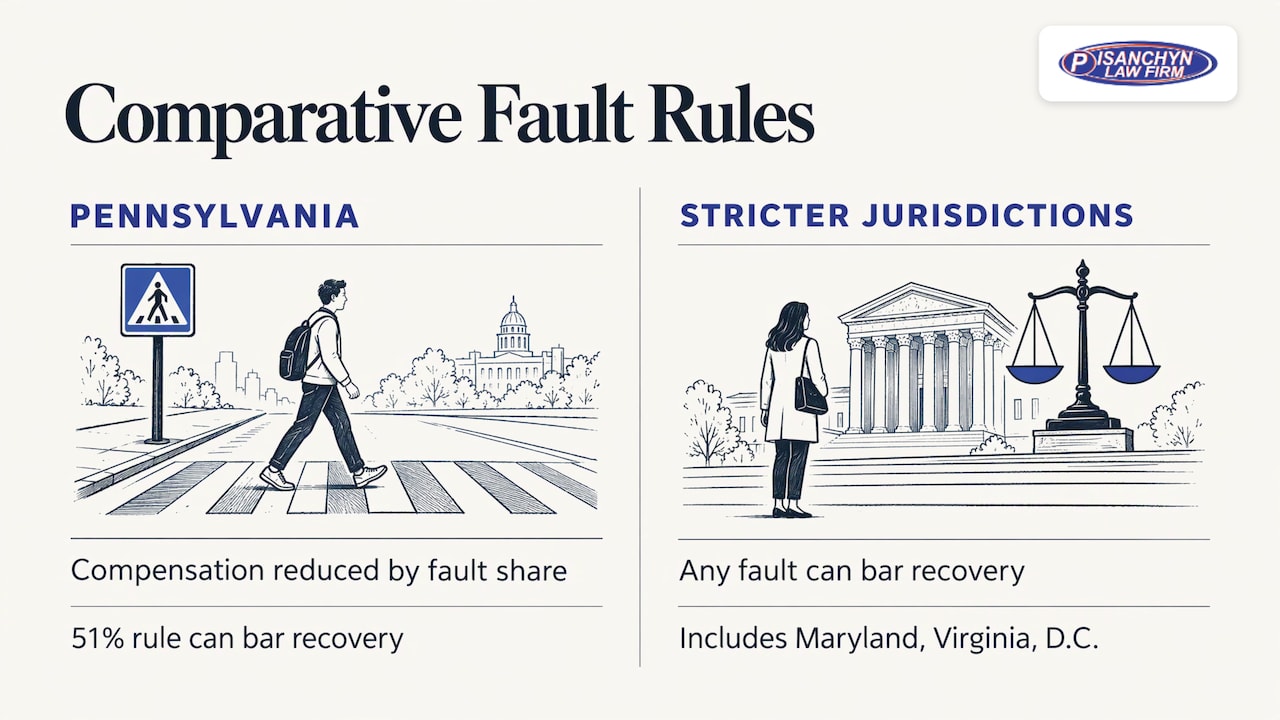
Pennsylvania is a modified comparative fault state. Your compensation is reduced by your percentage of fault, and if your share passes the legal threshold, recovery can be barred. Dear Legal’s summary of Pennsylvania law describes this as the 51% rule. A handful of other jurisdictions, including Maryland, Virginia and Washington, D.C., are stricter and bar recovery for any fault, according to Lawfold.
The practical lesson is simple: never agree with an adjuster that you “could have been more careful.” Every percentage point they assign to you comes straight out of your recovery. Your attorney’s job is to push that number down and the driver’s share up.
What compensation can cover
Justia lists the damages available in a pedestrian case: medical expenses, lost wages, reduced earning capacity, pain and suffering, loss of enjoyment of life and damaged personal property. A fuller picture of a serious claim also includes future care, assistive devices and transportation costs, as JusticeFinder’s claim process guide breaks down.
Three things affect how much you can actually collect:
- Fault. Any share assigned to you reduces the award.
- Insurance limits. The driver’s policy, and your own coverage, can cap practical recovery. InjuryMath notes that policy limits and applicable no-fault rules affect what is available.
- Liens and costs. Health insurers and others may claim part of a settlement, and case expenses come out of the recovery.
Be wary of anyone who quotes a settlement figure before your medical picture is clear. Serious claims should generally wait until your condition has stabilized, so the demand reflects what you will need in the future, not only what you have spent so far. If you are hurt and uninsured, read our guide on what happens next if you have no health insurance in Pennsylvania.
Deadlines you cannot miss
In Pennsylvania, the general rule is two years from the date of injury to file a personal injury lawsuit, found in 42 Pa. C.S. § 5524. Other states differ: Nolo reports that Nebraska allows four years for injury suits and two for wrongful death, for example.
The lawsuit deadline is not the only clock. House Legal warns that claims against government or public-transit bodies can carry notice periods of weeks or months, and insurance notice or benefit applications can run on separate timelines. If a city vehicle, a transit vehicle or a poorly maintained crossing was involved, talk to an attorney immediately.
If a pedestrian died, the family may have a wrongful death claim. Our overview of Pennsylvania wrongful death claims explains who can bring one.
How lawyer fees work
Pedestrian cases are normally handled on contingency. Cornell’s Legal Information Institute explains that the lawyer takes a percentage of the award instead of billing hourly, and that the agreement must be in writing and signed by the client. FindLaw reports that these arrangements generally fall between 30% and 40% of the settlement, with no lawyer’s fee if the case is not won.
At Pisanchyn Law Firm, you owe no attorney’s fee until we obtain a settlement. That lets you hire representation while you are out of work and facing medical bills.
Work with a Pennsylvania pedestrian injury team
We have more than 20 years of experience representing injured people across Pennsylvania, with offices serving Scranton, Wilkes-Barre, Harrisburg, Pittsburgh and Philadelphia. We have settled over $100 million for our clients. We prepare each case thoroughly, use a network of expert witnesses, and stay available to you throughout your recovery.

If you or someone you love was hit on foot, contact Pisanchyn Law Firm before you speak with the other driver’s insurer. If a cyclist was hurt rather than a pedestrian, see our bicycle accident attorneys, and for crashes caused by a dangerous road or crossing, our roadway defect accident attorneys. To understand the road ahead, read what happens after hiring a personal injury lawyer.
FAQ
Do I need a lawyer if the driver admits fault?
An admission at the scene does not guarantee the insurer will pay fairly. Drivers change their stories, and insurers still dispute fault and the extent of your injuries. An attorney makes sure your losses are documented and valued in full before you accept anything.
What if I was crossing outside a crosswalk?
You may still have a claim. Under a modified comparative rule, a share of fault assigned to you reduces your recovery rather than automatically ending it, unless your share passes the legal threshold. Do not give a recorded statement before speaking with an attorney.
How long do I have to file in Pennsylvania?
The general deadline for an injury lawsuit is two years. Claims involving government bodies can require much earlier notice, so act quickly if a public vehicle or road was involved.
How much is my pedestrian accident claim worth?
There is no standard figure. Value depends on your medical costs, future care, lost income, pain and suffering, fault and the available insurance. A reliable estimate comes only once your treatment picture is clear.
Will I pay anything upfront?
No. We work on a contingency basis, so you owe no attorney’s fee unless we win a settlement or award for you.
Sources
- Hit By a Car as a Pedestrian, Nolo
- Pedestrian Accident Law, Justia
- 75 Pa.C.S. § 3542, FindLaw
- Forensic Meteorology Services
- Pedestrian Accident Lawsuit: Who Pays When a Car Hits You, InjuryMath
- Pennsylvania Personal Injury Law Explained, Dear Legal
- Pedestrian Hit by Car Lawsuit, Lawfold
- Pedestrian Accident Injury Claim Process, JusticeFinder
- Nebraska Car Accident Laws, Nolo
- Bicycle and pedestrian accidents, House Legal
- Contingent fee, Cornell Legal Information Institute
- How Much Will It Cost to Hire a Lawyer?, FindLaw
Recommended
- Accident Lawyer Car Accident Lawyer
- Pedestrian Accident Attorneys
- Pedestrian Accident on Main Ave in Scranton
- How a Car Accident Lawyer Can Help You Navigate the Legal Process in Pennsylvania Introduction