

A no win, no fee lawyer charges no attorney’s fee unless your case recovers money through a settlement or a court award. In the United States this is called a contingency fee. At Pisanchyn Law Firm, you pay no fee until a settlement is achieved, so an injury, a death in the family or a denied disability claim does not have to wait on your ability to pay a retainer.
TL;DR
- “No win, no fee” and “no win, no pay” both describe a contingency fee: the lawyer is paid a percentage of what is recovered, and nothing if nothing is recovered.
- The American Bar Association says the percentage is often one-third to forty percent of the amount recovered.
- Pennsylvania requires the agreement in writing, with the percentages and the expenses spelled out.
- Case costs are separate from the attorney’s fee. Read how they are handled before you sign.
- Social Security disability fees are set by federal rules, not by the firm.
Table of Contents
- What “no win, no fee” means in practice
- How the fee is calculated
- Fees versus case costs
- What Pennsylvania requires
- What to check before you sign
- Does it work the same for every injury claim?
- How we handle the fee
- Deadlines matter more than fees
- FAQ
- Sources
What “no win, no fee” means in practice
The phrase is advertising shorthand. The legal term is a contingent fee agreement. You hire the attorney without paying by the hour, and the attorney’s compensation depends on the result. If the case settles or is won at trial, the attorney takes an agreed share of the recovery. If it does not, you owe no attorney’s fee.
This is why injured people who are out of work, facing medical bills and dealing with an insurance adjuster can still bring a claim against a well-funded opponent. It also aligns the lawyer’s interest with yours: a larger recovery is better for both of you.
Our firm handles cases on this basis across Pennsylvania, including car accidents, workers’ compensation, medical malpractice, wrongful death, dog bites and Social Security disability appeals. You can read our own explanation of contingency fee personal injury cases in Pennsylvania.
How the fee is calculated
The fee is a percentage of the recovery. The ABA states that lawyers commonly accept a fixed percentage, often one-third to forty percent, and that if the client loses, neither the client nor the lawyer gets paid for the work. Some agreements use one rate from start to finish. Others use tiers: a lower percentage if the claim resolves before a lawsuit is filed, and a higher one if litigation begins or the case goes to trial.
That tiering is the first thing to look for. Ask where each rate starts: when a complaint is filed, when the case is set for trial, or when an appeal is taken.
A simple example with round numbers shows the effect. Suppose a claim resolves for $90,000 and the agreement says one-third at settlement. The attorney’s share is $30,000. Under a trial rate of 40 percent, the same $90,000 would carry a $36,000 fee. The rate is only half the picture, because costs also come out of the recovery.

Fees versus case costs
This is where many people are surprised. The attorney’s fee and the costs of building the case are two different things. Costs can include court filing charges, medical records, deposition transcripts and expert witness fees. The ABA notes that, win or lose, you probably will have to pay court filing charges, deposition costs and similar expenses unless the agreement says otherwise.
Two questions decide how this plays out for you:
- Who bears the costs if there is no recovery? Some agreements make repayment of advanced costs depend on winning. Others require reimbursement regardless of outcome.
- Are costs taken out before or after the fee is calculated? The ABA explains that this order changes your take-home amount and is often negotiable before you hire the lawyer.
The ABA’s own example makes the point. On a $12,000 recovery with a one-third fee, a client nets $5,900 if the fee is calculated first and $2,100 in costs follows. If the costs come off first, the client nets $6,600. Same case, same percentage, a $700 difference.
What Pennsylvania requires
Pennsylvania’s Rule of Professional Conduct 1.5© sets out what a contingent fee agreement must contain. According to 204 Pa. Code Rule 1.5, the agreement must be in writing and must state:
- how the fee is determined, including the percentage or percentages that apply at settlement, at trial or on appeal;
- the litigation and other expenses to be deducted from the recovery;
- whether those expenses are deducted before or after the contingent fee is calculated.
The same rule bars contingent fees in domestic relations matters tied to a divorce or the amount of alimony or support, and for defending a criminal case. Injury, death and disability claims are the kind of cases where the contingency model is used.
Other states set their own rules on costs. Some allow a lawyer to make repayment of advanced costs depend on the outcome. If you read an article or ad from another state, do not assume it describes Pennsylvania. The written agreement you sign here is what governs.
What to check before you sign
A good fee agreement leaves nothing to guess. Before you sign with any lawyer, make sure the paper answers these points:
The percentages. What share applies at settlement, at trial and on appeal, and exactly when does each begin?
The costs. Which expenses will be advanced, and are they repaid only from a recovery? Are they deducted before or after the fee?
The scope. Does the agreement cover the whole claim, including a lawsuit, or only the first stage?
Settlement authority. The decision to accept an offer should stay with you after your attorney’s advice.
Ending the relationship. What happens to the fee if you change lawyers?
Liens and the final accounting. Medical providers and insurers may have claims against your recovery. You should receive a written breakdown showing the gross amount, the fee, the costs and your net.
Ask for a sample calculation using a hypothetical recovery. If the numbers on paper match what you were told, you are in good shape.
Does it work the same for every injury claim?
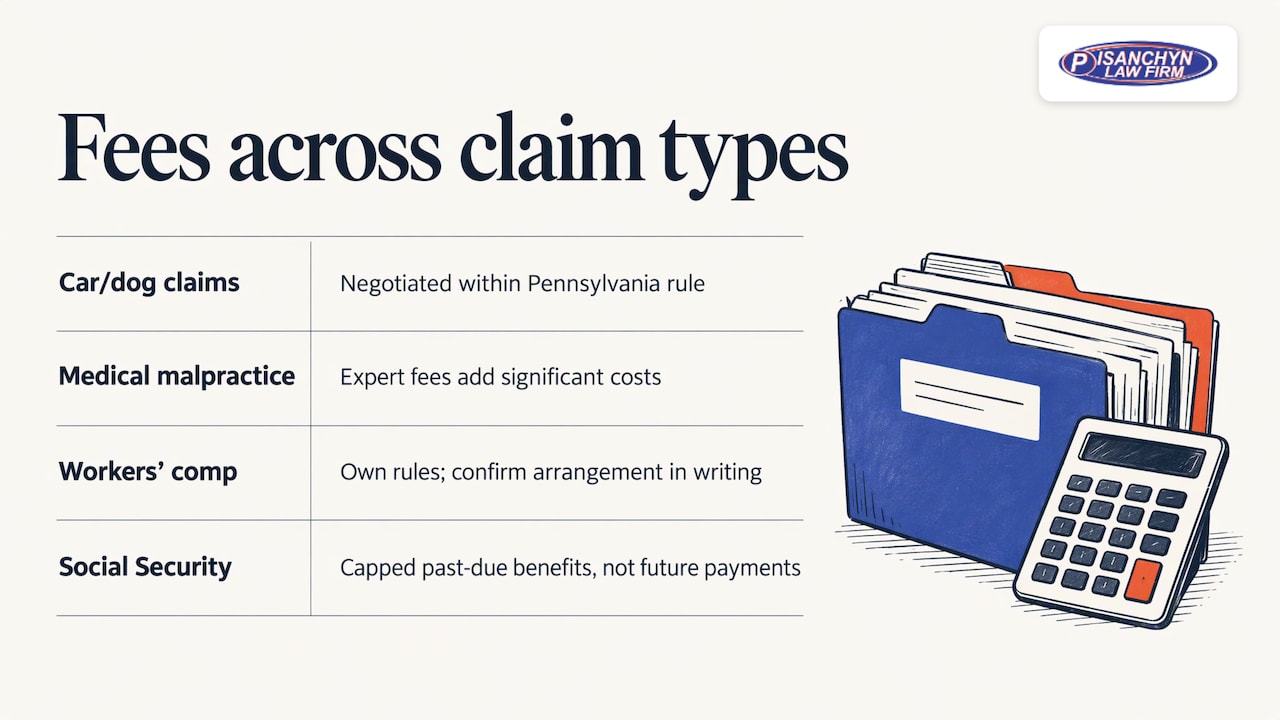
The basic idea is the same across the claims we handle, but the numbers differ.
Car, dog bite and other injury claims. The percentage is negotiated in the agreement, within the Pennsylvania rule above. Our pages on whether it is worth hiring a car accident attorney explain why representation tends to matter once an insurer disputes fault or value.
Medical malpractice and wrongful death. These cases usually depend on expert testimony, and expert fees are a significant part of the costs. That makes the cost clause above especially important to read. See how wrongful death claims work in Pennsylvania.
Workers’ compensation. Workers’ compensation fees are handled under their own rules, and you should confirm the arrangement in writing. If your claim was denied, our page on denied workers’ comp claims explains the process.
Social Security disability. Federal rules apply. The Social Security Administration states that once it approves a fee agreement, the fee in that agreement is the most the representative may charge and collect for all services on the claim. The fee is a capped share of past-due benefits, not of your future monthly payments. The dollar cap has been raised before, so confirm the current figure on the SSA’s page when you hire.
How we handle the fee
If you were hurt in Pennsylvania, you can speak with our attorneys about your case, and you pay no fee until a settlement is achieved. We represent injured people in Scranton, Wilkes-Barre, Harrisburg, Pittsburgh, Philadelphia and across the state, and our attorneys prepare each case around the client’s situation, with expert witness support where the claim needs it.

To talk through a claim, start at Pisanchyn Law Firm. Our guide on how to file a personal injury claim in Pennsylvania shows what the process looks like once you decide to move forward.
Deadlines matter more than fees
The fee structure should never be the reason you wait. Pennsylvania sets filing deadlines on injury claims, and evidence is easier to gather early: photographs, medical records, witness names, the other driver’s insurance details. Our overview of Pennsylvania personal injury laws covers deadlines and fault rules. Because the attorney’s fee depends on recovery, starting the conversation early costs you nothing in legal fees.
FAQ
Do I owe anything if we lose?
You owe no attorney’s fee if there is no recovery. Case costs are a separate question, and the answer is in your written agreement. Get that answer in writing before you sign.
What percentage does a no win, no fee lawyer take?
It is negotiated. The ABA says one-third to forty percent is common. Many agreements raise the rate if a lawsuit is filed or the case goes to trial, so check the stages.
Is a no win, no pay attorney the same as a no win, no fee attorney?
Yes. Both phrases describe a contingency fee arrangement. The lawyer is paid from the recovery, and only if there is one.
Is the agreement really required to be in writing?
In Pennsylvania, yes. Rule 1.5© requires a contingent fee agreement to be in writing and to state the percentages and the expenses to be deducted.
How are fees handled for a denied SSDI claim?
The SSA must approve the fee agreement, and the fee is capped at a share of past-due benefits. You never owe a share of future monthly benefits.
Sources
- How Do I Settle on a Fee with a Lawyer? (American Bar Association)
- 204 Pa. Code Rule 1.5. Fees
- Fee Agreements (Social Security Administration)
Recommended
- Contingency Fee Personal Injury Cases in Pennsylvania
- How to File a Personal Injury Claim in Pennsylvania
- A Step-by-Step Guide to Filing a Personal Injury Claim in Pennsylvania
- What Happens When You File an Injury Claim in PA