

A contingency fee means you pay your personal injury lawyer nothing up front. The lawyer is paid only if you recover money, and the fee is a percentage of that recovery. If there is no settlement or verdict, you owe no attorney’s fee. In Pennsylvania, that agreement must be in writing, and it must spell out the percentages and how case expenses are handled.
This guide explains how the arrangement works, what percentages are common, how a real settlement divides up, and which questions to ask before you sign.
TL;DR
- A contingency fee is a percentage of your recovery. You owe no attorney’s fee if the case does not win money.
- Rates of 33% to 40% are commonly reported for injury cases. Pennsylvania does not set one fixed rate, so the percentage is part of your agreement.
- Case costs (filing fees, experts, records) are separate from the fee. The agreement must say whether they come out before or after the fee is calculated, and that order changes your take-home amount.
- Pennsylvania’s deadline for most injury lawsuits is 2 years, so do not wait to talk to a lawyer.
Table of Contents
- What a contingency fee is
- What Pennsylvania requires in the agreement
- How much do contingency fees cost in Pennsylvania?
- Fee versus costs: the part people miss
- A worked example: a $50,000 settlement
- Contingency fee versus retainer or hourly billing
- Our perspective on contingency fees
- Questions to ask before you sign
- Why timing matters in Pennsylvania
- How we can help
- FAQ
- Sources
What a contingency fee is
A contingent fee is a way of paying a lawyer with a share of the client’s monetary award instead of billing a fixed hourly rate. The American Bar Association notes that the arrangement is used only where money is being claimed, most often in personal injury cases.
That is why you see it in car crashes, slip-and-falls, medical malpractice and wrongful death claims. It is not used in criminal defense and in most family law matters, because those cases usually have no monetary award to pay the fee from.
For an injured person, the practical effect is simple. You do not have to find thousands of dollars for a retainer while you are out of work and paying medical bills. The firm takes on the risk of a case that ends with nothing.
What Pennsylvania requires in the agreement
Pennsylvania’s Rule of Professional Conduct 1.5 sets the ground rules. A contingent fee agreement must be in writing. It must state:
- How the fee is determined, including the percentage that applies if the case settles, goes to trial or goes to appeal.
- Which litigation and other expenses will be deducted from your recovery.
- Whether those expenses come out before or after the contingent fee is calculated.
The same rule says the overall fee must not be illegal or excessive. The American Bar Association puts the standard as a fee that is reasonable from an objective point of view, tied to the services provided, the time invested, the expertise involved and the difficulty of the matter.
If a lawyer offers you only a handshake, or a document that leaves out any of the three items above, ask for a proper written agreement before you go further.
How much do contingency fees cost in Pennsylvania?
There is no single Pennsylvania rate. Only 6 of 51 U.S. jurisdictions cap contingency fees in ordinary injury cases. Elsewhere the limit is what a court would consider reasonable, so the rate is a matter of agreement. The same source reports a 33% to 40% range for Pennsylvania car accident cases and says the percentage is negotiable.
A Philadelphia-area law firm describes 33 1/3% as a standard fee, and says the fee usually goes up once a lawsuit is filed or the case goes to trial. Those are other firms’ descriptions of the market, not our rates, and every agreement is different.
Here is what usually moves the percentage:
- Stage of the case. A claim settled before a lawsuit is filed often carries a lower percentage than one that goes through litigation or trial.
- Complexity. A rear-end collision with clear fault differs from a medical malpractice case that needs several expert witnesses.
- Expected work and cost. Cases that take years and heavy investment cost the firm more to carry.
- Type of claim. Workers’ compensation and Social Security disability claims follow their own fee rules, so ask about them separately rather than assuming the personal injury rate applies.
Fee versus costs: the part people miss
The fee pays for the lawyer’s work. Costs are what the case itself spends: court filing fees, medical records, expert reports, depositions, investigators. A firm typically advances these as the case moves, and the agreement says how you reimburse them from the recovery.
Two questions matter here:
- Before or after? Are costs subtracted first and the percentage taken from what is left, or is the percentage taken from the gross amount and costs subtracted afterward?
- What if we lose? Some agreements waive costs if there is no recovery, and some do not. Ask directly. “No fee” does not automatically mean “no costs.”
A worked example: a $50,000 settlement
People often ask how much of a $50,000 settlement they would keep. The numbers below are an illustration only, using a 33 1/3% fee and $2,000 in case costs. They are not a quote or a promise about any case. They also leave out medical liens and health insurer reimbursement, which can reduce your net further.
| Costs deducted first | Fee on gross, then costs | |
|---|---|---|
| Settlement | $50,000.00 | $50,000.00 |
| Costs deducted before fee | $2,000.00 | $0.00 |
| Fee base | $48,000.00 | $50,000.00 |
| Attorney’s fee (33 1/3%) | $16,000.00 | $16,666.67 |
| Costs deducted after fee | $0.00 | $2,000.00 |
| You receive (before liens) | $32,000.00 | $31,333.33 |
The gap is $666.67 on a modest case. On a six- or seven-figure recovery, the order of deduction can mean thousands of dollars, which is why the written agreement matters.
Fee percentages also interact with the size of the case. A cost report on employment lawyers points out that contingency can look expensive next to hourly billing when a settlement is large. But it works as insurance: the firm absorbs the risk of a zero-dollar outcome, which most people could not carry themselves through long litigation.
Contingency fee versus retainer or hourly billing
The other common models work very differently.
| Contingency | Hourly with retainer | |
|---|---|---|
| Paid when | Only if you recover | As work is done |
| Upfront cost | None for the fee | A deposit the lawyer bills against |
| Who carries the risk | The law firm | You |
| Cost grows with | The size of the recovery | The hours worked |
| Best suited to | Injury and other money-recovery claims | Defense work, contracts, business disputes |
The same cost report puts hourly employment-law rates at $250 to $600 per hour, with upfront retainers of $5,000 to $25,000. That is employment law, not injury work, but it shows the scale of what hourly billing can demand. A retainer is also not a flat fee: unearned retainer money is supposed to be held until the lawyer earns it, and you should read the refund terms in any retainer agreement.
For a person hurt in a crash or on the job, paying hourly against an insurance company’s defense team is rarely realistic. Contingency lets the case be fought on the facts, not on your bank balance.
Our perspective on contingency fees
At Pisanchyn Law Firm, we represent injured people across Pennsylvania in personal injury, workers’ compensation and disability matters. Contingency is the only way most of our clients could afford to bring a serious claim, and we work on a no-win, no-fee basis. You pay no legal fees unless we win your case.
We think the fee conversation should happen in the first meeting, not after you are committed. Here is how we look at it:
- Read it before you sign. The percentages, the costs and the order of deduction should all be on paper, in plain words. If something is unclear, we explain it.
- Trial readiness changes the value of the fee. We prepare every case as if it may go to trial. Insurers can tell which lawyers are ready to try a case and which are not, and that affects offers.
- Compare net recovery, not just percentage. A lower percentage with weak preparation can leave you with less than a fair percentage and a strong result.
- You should have direct access. A fee agreement is also a working relationship. You should know who is handling your case and be able to reach them.
We have secured over $100 million in settlements for clients over more than 20 years. That record is about outcomes, and it is not a guarantee for your case, because every claim depends on its own facts.
— Brian
Questions to ask before you sign
Use this list with any firm, including ours.
- What percentage applies if the case settles before filing, after filing, at trial and on appeal?
- Are costs deducted before or after the fee is calculated?
- If we lose, do I owe any costs?
- Who pays for experts, and who approves large expenses?
- How are medical liens handled, and will you negotiate them?
- Who will actually work on my case?
- When will I receive a closing statement showing every deduction?
Good answers come quickly and in writing. Vague answers are a signal to keep looking.
Why timing matters in Pennsylvania
Contingency removes the cost barrier, but it does not stop the clock. Pennsylvania’s statute of limitations is generally 2 years from the date of injury for personal injury negligence claims such as car accidents and slip-and-falls (42 Pa.C.S. § 5524). Workers’ compensation claims must generally be filed within 3 years of the injury (77 P.S. § 602). Missing the deadline typically ends the claim for good. The statutory text for injury or death caused by negligence also lists the 2-year period.
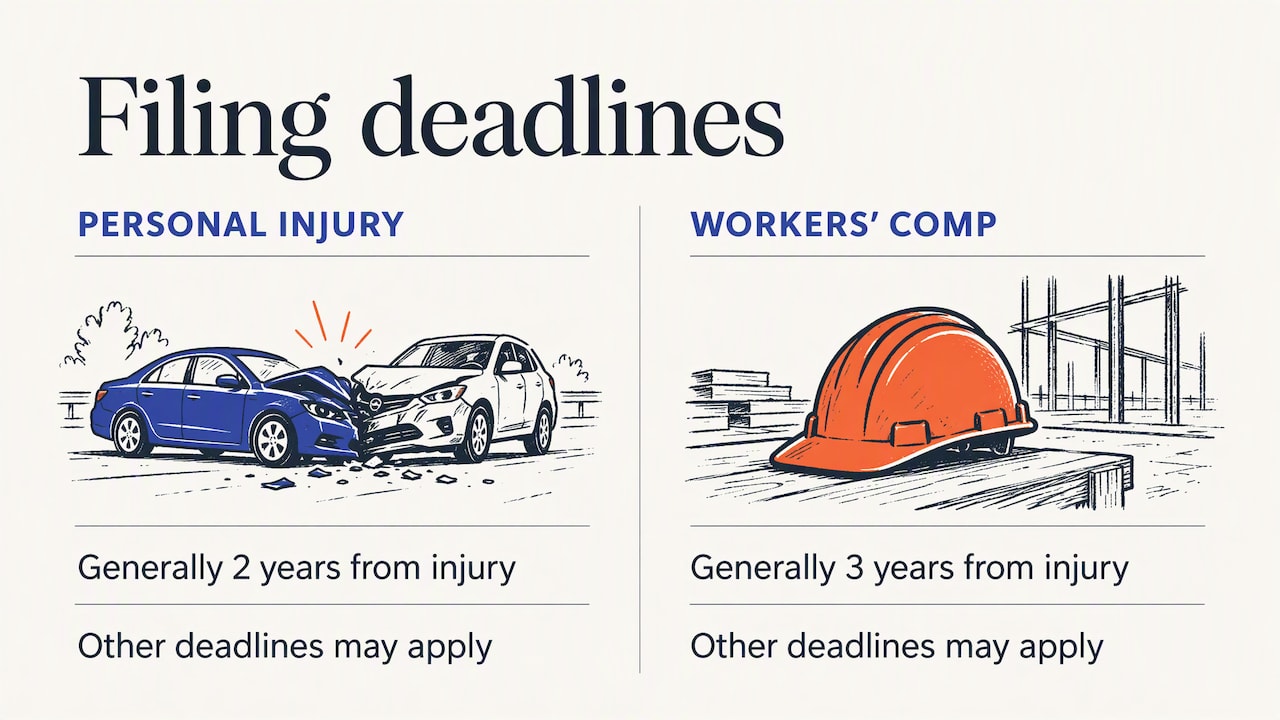
Some situations have different or shortened deadlines, for example claims involving government entities. If you were hurt more than a few months ago, speak with a Pennsylvania attorney now and let them confirm which deadline applies to you. Evidence also fades: surveillance video is overwritten, and witnesses move away.
How we can help
If you were hurt in a car or truck crash, at work, in a hospital or on someone else’s property, our team handles these claims on contingency. You can see the kinds of cases we take on our personal injury practice page, and our practice areas cover medical malpractice, product liability and more.
Injured at work? We handle workers’ compensation claims for employees in many settings. Local clients can also reach our Pittsburgh car accident lawyers or Harrisburg car accident lawyers. Start with a conversation through our main site. We will explain how the fee works for your case before you decide anything.
FAQ
What are contingency-based fees?
They are fees paid only if your lawyer wins money for you. The lawyer takes an agreed percentage of the settlement or verdict, and you owe no attorney’s fee if there is no recovery. In Pennsylvania the agreement must be in writing.
What is the contingency fee percentage in Pennsylvania?
There is no fixed statewide percentage for ordinary injury cases. Figures of 33% to 40% are commonly reported, and the rate is negotiable. The percentage often rises if a lawsuit is filed or the case goes to trial, so check each stage in your agreement.
How much of a $50,000 settlement would I get?
At a 33 1/3% fee and $2,000 in costs, you would receive roughly $31,333 to $32,000 before medical liens, depending on whether costs come out before or after the fee. Your own agreement and any liens decide the real figure.
Is a contingency fee better than a retainer or hourly rate?
For injury claims, usually yes. You pay nothing up front, and the firm carries the risk of losing. Hourly billing and retainers suit defense and business matters, where there is often no recovery to pay a fee from.
Do I pay anything if I lose?
You owe no attorney’s fee. Whether you owe case costs depends on your agreement, so ask that question before signing. At our firm, you pay no legal fees unless we win your case.
Sources
- Pennsylvania Rule of Professional Conduct 1.5, Fees
- Contingent fee, Legal Information Institute (Cornell)
- Fees and Expenses, American Bar Association
- How Do I Settle on a Fee with a Lawyer?, American Bar Association
- Pennsylvania Car Accident Calculator, Settlement Insight
- Contingency Fee, Pennsylvania personal injury resources
- Employment Lawyer Fees in 2026, Real Cost Report
- Retainer and Contingency Agreements, LegalMatch
- Personal Injury Laws in Pennsylvania, Observed
- Pennsylvania statutes of limitations (PDF)
Recommended
- Harrisburg Catastrophic Injury Lawyers
- Scranton Catastrophic Injury Lawyers
- Motorcycle Accident Attorneys
Made with BabyLoveGrowth to build backlinks