

A traumatic brain injury claim is a legal demand for compensation from the person or company whose wrongful act or failure to act caused a blow, jolt or penetrating injury to your head. To win one, you must prove the other party was at fault, that you were hurt, and that the fault caused the harm. Because brain injury symptoms can be slow to show and hard to measure, the strength of your claim often depends on what you document in the first days and weeks.
TL;DR
- A TBI claim rests on three things: wrongful conduct, a real injury, and a link between the two.
- Symptoms can appear hours or days after the injury, so get medical care and keep records right away.
- Compensation can cover medical care, lost income, and pain, suffering and lasting disability.
- Claims differ by source: car crashes, workplace injuries, medical negligence and wrongful death each follow different rules and deadlines.
- Every state sets a filing deadline. Speak with an attorney early so evidence is not lost.
Table of Contents
- What counts as a traumatic brain injury
- Who can bring a claim
- What you must prove
- Why symptoms and timing matter
- Evidence that supports a TBI claim
- What compensation can cover
- How the type of claim changes the process
- Deadlines you cannot ignore
- Protect your claim from the start
- How we help with a brain injury claim
- FAQ
- Sources
What counts as a traumatic brain injury
The CDC describes a TBI as an injury caused by a bump, blow or jolt to the head, or a penetrating head injury, that disrupts normal brain function. According to its surveillance report, TBI was identified in 25% of all injury-related deaths in 2017, and national TBI-related deaths numbered 60,565 in 2018 and 60,611 in 2019.
Most brain injuries are not the dramatic kind. A peer-reviewed review finds that 75 to 85% of TBI cases are mild, with a Glasgow Coma Scale score of 13 to 15, and that 15 to 30% of people with a mild TBI develop prolonged cognitive and behavioral changes. “Mild” describes the initial severity score. It does not describe what the injury can do to your work, your memory or your family life.
Injuries fall into two broad groups. A closed head injury happens when the skull stays intact but the brain is shaken or bruised. An open head injury involves a penetrated or fractured skull. Some people also experience post-traumatic amnesia, a period of confusion and memory loss after the trauma, which doctors use to gauge severity.
Who can bring a claim
You may have a claim if someone else’s carelessness or wrongful act caused your injury. Common settings include car, truck and motorcycle crashes, falls on unsafe property, construction and workplace accidents, defective products, and medical errors, including surgical mistakes and missed diagnoses.
If a brain injury killed a loved one, certain family members may be able to bring a wrongful death claim. Our page on Pennsylvania wrongful death claims explains how those cases work.
What you must prove
Nolo explains that a brain injury claim requires proof that someone acted or failed to act wrongfully, that you were injured, and that the wrongful act caused or contributed to the injury. Proof of negligence alone does not create a viable claim. You also have to show the injury and the causal link.
In practice, that means answering four questions:
- Did the other party owe you a duty of care, such as a driver to other motorists or a property owner to visitors?
- Did they breach that duty?
- Did the breach cause your brain injury?
- What harm resulted, in dollars and in daily life?
The causation question is where TBI cases are most often fought. Insurance companies look for another explanation: a prior condition, a mental health diagnosis, or the claim that you simply were not hurt that badly.
Why symptoms and timing matter
The CDC notes that some mild TBI and concussion symptoms appear right away, while others may not appear for hours or days, and symptoms can change during recovery. Headaches may come first, with emotional changes or sleep trouble a week or two later. The CDC also says these symptoms differ from person to person, can be hard to tell apart from other health problems, and that a person may not recognize or admit they are having problems.
That has two practical consequences:
- See a doctor even if you feel “fine.” A same-day or next-day record ties your symptoms to the event.
- Let family and coworkers speak up. They often notice irritability, forgetfulness or personality changes before you do. Their observations become part of your proof.
Insurers read a delay in treatment as a sign that the injury was minor. A medical record made soon after the incident helps answer that argument.
Evidence that supports a TBI claim
Brain injuries do not always show up on a scan. Headinjury.com notes that current imaging and blood tests can’t always detect damage from mild, concussive injuries. A strong claim therefore combines several kinds of evidence:
- Emergency, hospital and follow-up treatment records, including scans and any loss-of-consciousness or amnesia notes.
- Neuropsychological testing that measures memory, attention, processing speed and judgment.
- Employment records showing how your work performance, hours or earnings changed.
- Photos, crash reports, witness statements, surveillance video and vehicle data from the incident itself.
- A daily journal of headaches, sleep, mood and tasks you can no longer do.
- Statements from family, friends and coworkers about the change they have seen in you.
An article in the American Association for Justice’s Trial magazine advises that, to counter disability defenses in TBI cases, lawyers should start with objective physical abnormalities such as abnormal neuroimaging, reinforce them with clinical signs like impaired balance and altered vision, and use comprehensive neuropsychological evaluations to separate organic brain injury from a mental health condition. The same article warns that fatigue is a gray area insurers often attribute to mental health, and that opinions from treating and consulting medical experts tying its pattern to the TBI can help counter that.
This is why expert support matters. Our firm prepares each case with a network of expert witnesses so that the medical story is told clearly and backed by qualified professionals.
What compensation can cover
Nolo lists economic damages that may include medical bills, rehabilitation and care, equipment, in-home care, home modifications, and lost wages and benefits. Noneconomic damages may include emotional distress, disability, pain and suffering, and loss of consortium.
The value of a claim is not a fixed number. It depends on the severity of the injury, how long it lasts, how it changes your ability to work, the cost of future care, and the insurance coverage available. Severity is often described through the Glasgow Coma Scale, the length of post-traumatic amnesia and the length of any loss of consciousness, but a lower score at the scene does not cap what a brain injury can take from you later.
To understand how each category works, read our guide to the types of damages people can recover. Pain and suffering is the hardest category to prove and the easiest to undervalue, so our article on how to prove pain and suffering is worth your time.
How the type of claim changes the process
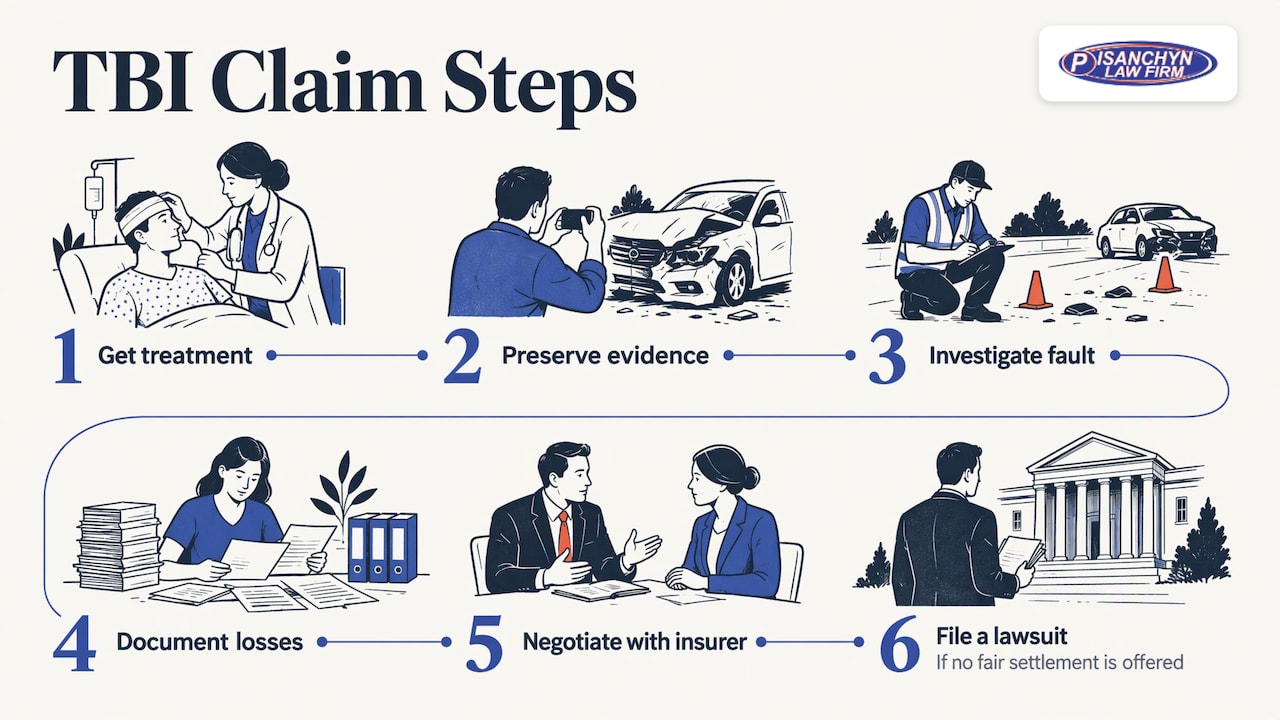
The steps in a TBI claim are broadly the same: get treatment, preserve evidence, investigate fault, document your losses, negotiate with the insurer, and file a lawsuit if a fair settlement is not offered. What changes is who you are up against and which rules apply.
Crash and premises cases. These are usually claims against a driver, a trucking company or a property owner, and their insurers. Evidence disappears quickly, from vehicle data to video footage.
Workplace injuries. A head injury on the job usually runs through the workers’ compensation system, which has its own filing requirements and benefit rules. If a third party such as a contractor or equipment maker contributed, a separate injury claim may also be possible. See our overview of denied workers’ comp claims if your claim has been turned down.
Medical negligence. A birth injury, a missed stroke or bleed, or a surgical error can cause or worsen a brain injury. These cases generally require expert medical review. Learn more in our guide to medical malpractice rights and remedies in Pennsylvania.
Wrongful death. When a brain injury is fatal, eligible family members pursue a claim for their losses. These claims have their own rules about who may file.
Deadlines you cannot ignore
Every state sets a time limit for filing an injury lawsuit, and the limit can differ by state and by type of claim. Claims against a government body, medical providers or an employer’s insurer can carry different or shorter notice requirements. Once a deadline passes, your right to compensation can be lost no matter how serious your injury is.
Because brain injuries can take time to reveal their full effect, do not wait to see how recovery goes. Our article on the right time to contact a personal injury attorney explains why early contact protects you. An attorney can confirm the deadline that applies to your situation.
Protect your claim from the start
- Get examined and follow every treatment recommendation.
- Keep all medical bills, pay stubs and correspondence.
- Be careful with recorded statements to an insurer. Adjusters are looking for anything that downplays your injury.
- Do not sign a release or accept a settlement before you understand your long-term needs.
- Stay off social media posts that show you active without context.
How we help with a brain injury claim
Our firm has more than 20 years of experience handling serious injury cases across Pennsylvania, including traumatic brain injury claims. We gather evidence, work with expert witnesses, negotiate with insurers and take cases to court when needed. You pay no fee unless we obtain a settlement or award for you.

You can reach an attorney directly, and we are available to clients at all times. If you or a family member has suffered a head injury because of someone else’s conduct, contact Pisanchyn Law Firm for a conversation about your options, or see the full list of our practice areas.
FAQ
Can I file a claim if my symptoms showed up days later?
Yes. The CDC says some concussion and mild TBI symptoms may not appear for hours or days. What matters is documenting them promptly, seeing a doctor, and connecting the symptoms to the incident through medical records and the observations of people close to you.
Do I need a brain scan to have a claim?
Not necessarily. Imaging cannot always detect mild brain injury. Neuropsychological testing, treatment records, and testimony from medical experts can show cognitive and functional impairment even when a scan looks normal.
What compensation can a TBI claim include?
It can include medical and rehabilitation costs, in-home care and equipment, lost wages and benefits, and noneconomic losses such as pain and suffering, emotional distress and disability. The amount depends on the severity, the permanence of your limitations and the available insurance.
How much does it cost to hire a brain injury attorney?
At Pisanchyn Law Firm, you pay no fee until a settlement or award is obtained. Our fee comes from a percentage of the recovery, so you can pursue your claim without paying legal fees up front.
Can family members file if a loved one died of a brain injury?
Often, yes. Certain relatives may be able to bring a wrongful death claim for the losses caused by the death. An attorney can tell you who is eligible and what deadline applies where the injury happened.
Sources
- CDC TBI Surveillance Report, 2018 and 2019
- The neuropathology of traumatic brain injury (PMC)
- CDC: Symptoms of Mild TBI and Concussion
- Nolo: Brain Injury Lawsuits and Potential Compensation
- AAJ Trial Magazine: Tackling Disability Defenses in TBI Cases
- Head Injury Resource Center
Recommended
- Traumatic Brain Injury Attorneys
- Post Traumatic Amnesia Attorneys
- Closed Head Injury Attorneys
- Open Head Injury Attorneys