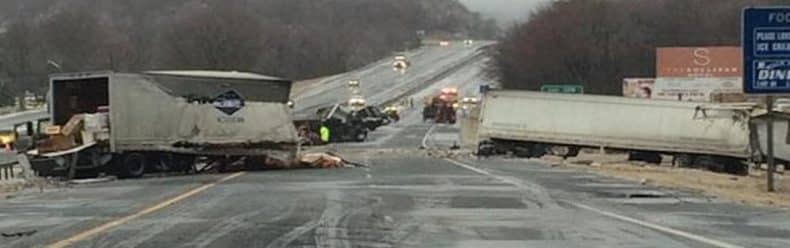

A tractor-trailer has large blind spots on all four sides: directly in front of the cab, directly behind the trailer, and along both sides. Safety agencies call them no-zones. If your car is in one, the truck driver may not see you at all. If you were hurt in one of these crashes, you may have legal options, and we explain them below.
TL;DR
- A semi has four no-zones: in front, behind, and along both sides. The right side is the most dangerous.
- The rear no-zone can reach about 200 feet, and the front no-zone about 10 to 20 feet.
- Pass on the left, pass quickly, and only move back over when you can see the truck’s front grille in your rearview mirror.
- If a blind spot crash injured you or a family member, a truck accident attorney can investigate who is responsible.
Table of Contents
- What a truck’s no-zones are
- How far the blind spots reach
- Why the right side is the most dangerous
- Why drivers miss what is in a blind spot
- What blind spot crashes look like
- How to drive safely around trucks
- If a blind spot crash hurt you or your family
- Talk to a Pennsylvania truck accident attorney
- FAQ
- Sources
What a truck’s no-zones are
Due to their size and height, semi trucks have several large areas where a car can virtually disappear from the driver’s view. The four areas to avoid are the front, the rear, and both sides of the tractor back to the front of the trailer. Wisconsin’s DMV makes the same point: a large truck has four serious blind spots, and a car sitting in one limits the trucker’s ability to react to danger.
The key problem is that a truck driver cannot simply glance over a shoulder the way you can. There is no rearview mirror to look through, so the driver depends heavily on side mirrors. Those mirrors can be as tall as 25 inches, according to the Vermont DMV, and they still leave gaps.
How far the blind spots reach
Distances vary by source and by truck, so treat them as a guide for how much room to leave, not as a precise line on the pavement.
| Area | What agencies report |
|---|---|
| Front | 10 to 20 feet in front of the cab |
| Rear | Up to 200 feet behind the trailer, about two-thirds of a football field |
| Driver’s side | Starts near the side mirror and angles out about one lane, back to about midway along the trailer |
| Passenger’s side | Angles out about two lanes and extends back past the trailer’s rear wheels |
The side descriptions come from Sentry Insurance’s no-zone guide. The takeaway is simple: the passenger side, the right side, is the larger and more dangerous one.
Why the right side is the most dangerous
The NTSB has said the blind spot on the right side of a tractor-trailer is of particular concern. It covers a large part of the driver’s field of view and is disproportionately involved in collisions with pedestrians, cyclists, and passenger vehicles.
Research from the University of Michigan found that right-side crashes occurred over four times more often than left-side ones in the lane-change and merge category it studied. The same report notes that about 70 percent of conventional-cab trucks have a right fender mounted mirror that fills in part of the view along the front right side. Trucks without one may be significantly overinvolved in crashes.
The lesson for you as a driver is plain. Never pass a truck on the right if you can avoid it, and never sit beside the cab on that side.
Why drivers miss what is in a blind spot
Blind spots are not the only reason a trucker fails to see a car. The FMCSA describes inadequate surveillance as a driver who fails to look in the right place or looks but does not see. It contributed to 14 percent of large-truck crashes in the federal Large Truck Crash Causation Study.
The NTSB adds that driver ride height, mirror and window placement, and the truck’s geometry can all affect whether a driver detects a passenger vehicle. Federal rules also set a floor, not a ceiling. According to a Volpe Center report, the federal mirror standard requires a flat rearview mirror on each side of the cab and no other mirror type.
So a crash in a blind spot can involve more than a driver’s momentary lapse. Mirror setup, fatigue, schedule pressure, training, and maintenance can all play a part. We cover those in our guides to common causes of truck accidents and what causes tractor trailer accidents in Pennsylvania.
What blind spot crashes look like
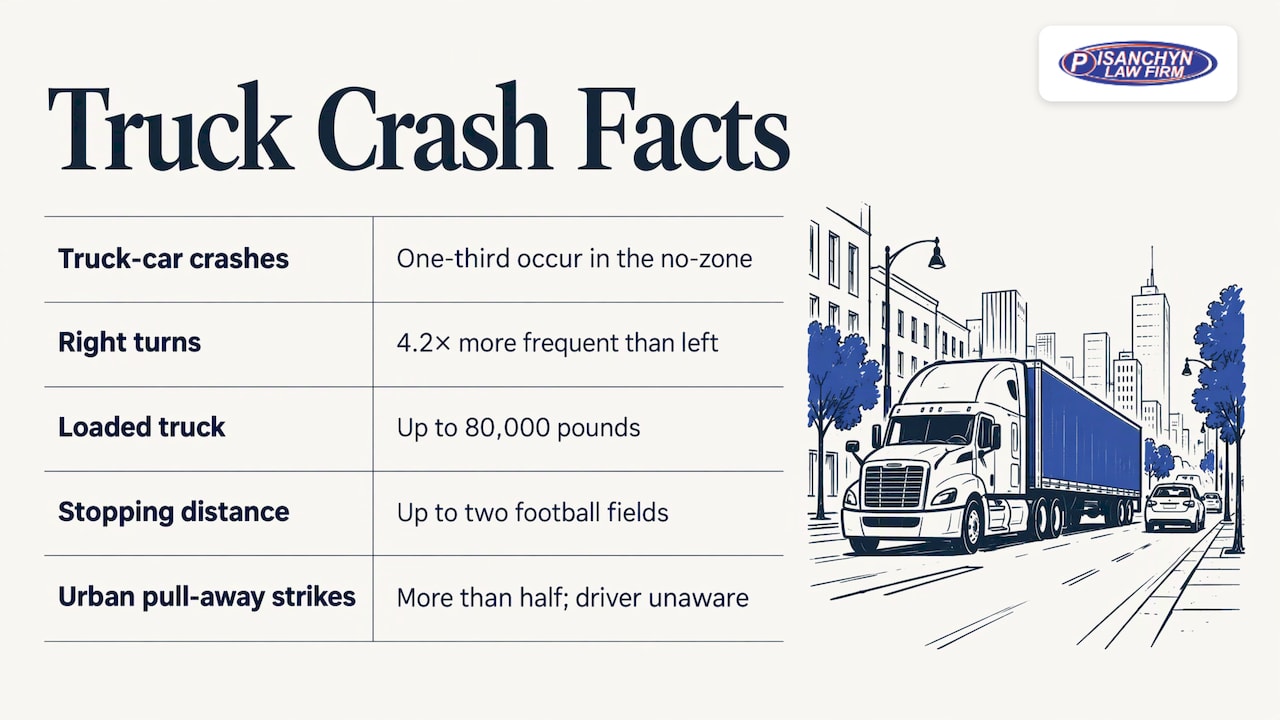
The FMCSA reports that one-third of all crashes between large trucks and cars take place in the no-zone. Most follow a few patterns:
Lane change and merge crashes. The truck moves into a lane the driver believed was empty. The Kansas Highway Patrol notes a simple lane change can cause a collision, create wind turbulence that pushes another vehicle into a different lane, or spray gravel and debris onto it.
Wide right turns. A car, motorcycle, or bicycle moves up on the right as the truck swings left to turn right. Research summarized by Reed in 2006 found right-turn crashes 4.2 times more frequent than left-turn crashes.
Rear and front crashes. A car tailgates a truck or cuts in front of it and brakes. A loaded tractor-trailer can weigh up to 80,000 pounds and may need the length of up to two football fields to stop.
Pedestrian and cyclist crashes. The NTSB found that in more than half of urban collisions where a truck pulled away from a stop and struck a pedestrian in a crosswalk, the driver did not know it had happened until bystanders alerted them.
Injuries from a collision with a vehicle this heavy are often severe, including spinal cord injuries, traumatic brain injuries, and fatalities.
How to drive safely around trucks
These habits come from the agencies above. They cannot remove all risk, but they put you where the driver can see you.
Check for the driver’s mirrors. If you cannot see the truck’s side mirror, the driver probably cannot see you.
Pass on the left, and pass with purpose. Kansas troopers advise passing with care, never on the right, and never lingering beside a truck. AAA notes that at highway speeds it can take up to 30 seconds to pass a truck safely, so start only when you have the room to finish.
Do not cut back in early. After passing, change lanes only when you can see the truck’s headlights or front grille in your rearview mirror. AAA says an average truck changing lanes at highway speed needs an eight-second gap, about 700 feet, so a car that squeezes in ahead takes away the truck’s stopping room.
Skip downhill passes. The Vermont DMV advises against passing trucks on hills or mountains, where they pick up speed because of their weight. That matters on Pennsylvania’s mountain stretches of interstate.
Back off. Do not tailgate. The rear no-zone is long, and a trailer that stops short leaves you no room.

If a blind spot crash hurt you or your family
What you do in the first days shapes a truck accident claim. Get medical care first. Then write down where the truck was and where you were, take photos if you can, and note any witnesses. Do not give a recorded statement to a trucking company’s insurer before you have talked to a lawyer.
Blame in a blind spot crash is rarely simple. A trucking company will often argue that you were in the no-zone and therefore at fault. A thorough investigation looks at the driver’s logs, the truck’s mirror setup and maintenance, the company’s training and dispatch practices, and any electronic data the truck recorded. Our pages on truck accident liability and trucking accident injury compensation explain who can be held responsible and what a claim can cover. If you lost a loved one, read about wrongful death claims in Pennsylvania.
Talk to a Pennsylvania truck accident attorney
Pisanchyn Law Firm represents people injured in truck and commercial vehicle crashes across Pennsylvania. We have over 20 years of experience, we prepare each case around the client’s own facts, and we work with expert witnesses. You pay no fee unless we win your case.
If you were hurt around a tractor-trailer, call us or contact our truck accident attorneys for a conversation about what happened. You can also read our guide on what to know about a big truck accident lawsuit, or see our full list of practice areas.
FAQ
What are the blind spots of a large truck called?
They are called no-zones. They are the areas around a truck where the driver has little or no view of other vehicles. They sit in front of the cab, behind the trailer, and along both sides.
Where are the biggest blind spots on a semi-truck?
The right side is the most dangerous. It stretches out about two lanes and back past the trailer’s rear wheels, according to Sentry’s description. The rear is the longest, reaching about 200 feet.
Can I be at fault if I was in a truck’s blind spot?
A trucking company may say so, but being in a no-zone does not settle who is responsible. Investigators also look at the driver’s conduct, the truck’s mirrors and equipment, and company practices. A lawyer can review the facts before you speak with an insurer.
How long do I have to see a lawyer after a truck crash?
Sooner is better, because evidence such as driver logs and electronic data can be lost. Our page on when to contact a personal injury attorney explains why timing matters.
Sources
- Know the No-Zones, Truck Smart (Utah DOT)
- Truck blind spots, Wisconsin DMV
- Know the No-Zones, Vermont DMV
- No-Zone Safety, North Carolina State Highway Patrol
- Sharing the Road: AAA’s Guide for Motorists and Truckers
- What’s A No Zone? Sentry
- NTSB safety recommendations H-14-001 through -007
- Truck mirrors, fields of view, and serious truck crashes, University of Michigan
- CMV Driving Tips: Inadequate Surveillance, FMCSA
- Cambridge Safer Truck Initiative
- Prioritizing improvements to truck driver vision, Reed 2006
- No Zone, Kansas Highway Patrol
- Tips for Passenger Vehicle Drivers, Vermont DMV
Recommended
- Summer Tractor Trailer Accidents in Pennsylvania
- What Causes Tractor Trailer Accidents?
- Injured by a Tractor Trailer? Pennsylvania Truck Accident Lawyers
- Pursuing a Big Truck Accident Lawsuit: What You Need to Know